Showing posts with label Japanese. Show all posts

Thursday, May 03, 2012

Surely Someday


It is often said that "imitation is the sincerest form of flattery." If that be true, then Guy Ritchie should be floored by the level of appreciation that Shun Oguri has shown for his use of slow motion effects and time lapse photography. Yes, the actor best known for playing Hanazawa Rui (Hana Yori Dango) and Suzuran faction leader, Takaya Genji (Crows Zero) has gone to the extent of crafting an outrageous, coming-of-age film that pays homage to [if not totally replicating] the cinematic style of Lock, Stock and Two Smoking Barrels, minus the narrative punch provided by a clever screenplay and the kickass factor contributed by Vinnie Jones or Jason Stratham.

I remember my sister telling me about this movie project in the same breath as sharing the latest rumors about Oguri being a horny dog, but I never really placed much thought into it since: (a) she couldn't tell me the title of the movie at that time; (b) Shun Oguri always struck me as the kind of actor who worked best in an ensemble, which, to me, meant that if he didn't have the draw or star power to carry the lead role, then chances are, he wouldn't have the ability to helm a full-length movie feature; and (c) I couldn't care less about which girl/jpop group member he banged at allegedly took to a motel.

About this time last year, I was doing some prep work for that Arashi post that I've always been meaning to do but never got around to doing, and even though the said post never materialized, I ended up watching a number of Japanese variety shows hosted by Japan's "national idols". One of the shows I managed to catch (thanks to fans who shared the said episode on a streaming site without the permission of the subber) happened to be Oguri's promotional guest stint at Arashi ni Shiyagare where I finally learned the movie title which was シュアリー・サムデイ or going by the boys' phonological speech, "Shuari Samudei".

*     *    *


In this dramedy of errors, penned by writer Shogo Muto, five high school friends barricade themselves in a classroom with a home-made bomb in protest of the cancellation of their school festival and the corresponding "annihilation" of their dream to perform as a band. Brimming with hope and the promise of being surrounded by adoring fans through their music, Takumi (Koide Keisuke), Kyohei (Katsuji Ryo), Hideto (Ayano Gou), Kazuo (Suzuki Ryohei) and Yuki (Muro Tsuyoshi) mount a successful campaign for the reinstatement of the festival but when they fail to defuse the prop time-bomb  they had set up to facilitate negotiations with the school administrators, the damage caused by the explosion would later prove to be monumental not only to the lives of these boys.

Surely Someday provides a spry yet unbalanced story about how chance encounters and circumstances can produce a ripple effect that would link two seemingly unrelated events that in the long run would produce irreversible consequences. There's a network of people involved in this slapdash tale, such that the connection drawn between these wayward teens and a former prostitute (Konishi Manami) would span a number of years, beginning with a summer childhood adventure to Kabukicho and a botched up sting operation. The film hurtles back and forth between the past and the present as all five find themselves tainted, unable to move on from the incident.

Now a feckless bartender, a third-rate college virgin, a fledgling yakuza, a street busker and a hikikimori find themselves in trouble once again as their past catches up with them. They have no choice but to make amends, find each other and reunite long enough to take care of unfinished business; what's more, they need to retrieve 300 million Yen before yakuza boss Kito (Yoshida Kotaro) sends his men to ice them.


Fun and upbeat, Surely Someday is a film that can not be taken seriously no matter how hard it tries to infuse its storyline with some edgy scenes and grim but oft times, shallow existentialist musings about lost youth and opportunities. It's full of high school hijinks and flailing commentary about people who put their life on hold, set to punk-rock music, peppered with drugs, money laundering, even some violence and undignified [non-metaphorical] boot licking. Decidedly the result of a well-meaning and excitable collaboration, the movie tends to be overbearingly gratuitous in its execution and unbelievably self-conscious in acquiring a modicum of street credibility amidst the fanfare. This is no Go or American Graffiti but a rollicking, hyper-comedic Japanese production containing familiar elements of what made a movie "cool" in the late 90s.

For a directorial debut, Surely Someday is quite a mediocre offering---it comes chock-full of novice mistakes, betraying the lack of vision or originality on the part of Oguri to work behind the camera and instruct his fellow actors towards achieving a good take. He seems to have approached the film as he would a goukon by calling in favors from friends and co-workers (judging by the number of cameos), giving them free rein to act and [over]react as they see fit without any instruction. There are indeed times when the scenes felt like an impromptu comedy sketch, given the hammy delivery of lines and the cast's acting choices.

There's also the sudden shift in tone with very little lead in, thus catching the viewer by surprise as the droll buffoonery of its first act gives way to an adorable yet short-lived segment featuring the characters' childhood, interrupted yet once again by some clumsy action, more melodrama and a failed Sugar & Spice routine set in the present. Oguri's artistic choices do not often work; the overdone 10-second recapitulation of each character's three-year activities, the white footprint suit donned by the yakuza boss,  or even  the slow motion off-target gangster shoot out set to the tune of Schubert's Ave Maria (which brings to mind the game Hitman), tend to be whimsical additions rather than valuable set pieces.

Despite its flaws, Surely Someday is, by all accounts, not a bad movie. There's enough story in it to keep a viewer entertained provided one can overlook the uneven acting. It would have been much better had there been competent and assured direction from Shun Oguri, however as it stands today, it's quite clear that his ambition appears to have exceeded his ability.
--------------------- 
 Photo credits/Movie Stills by Asiabeam and Ramen
Read More

Tuesday, July 26, 2011

BECK's Heav[enl]y Silence

"Please don't put your life in the hands
Of a Rock 'n Roll band and throw it all away"
- Oasis, Don't Look Back in Anger (1996)

Last month, I received the subtitles prepared by SkewedStudios Fansubs and Scanlations to the live-action version of BECK with instructions from the project leader to typeset the same, bearing in mind to place it on uber-hakaduper-higher-than-the-highest priority on my list of pending projects. Coming into it, I must confess that I was totally oblivious to the existence of the manga penned by Harold Sakuishi and inexcusably ignorant of the lauded anime version of the series. All I knew at the time was that fans of the manga were stoked to see it and girls were quite happy with the selection of pretty boys appearing in it.

Judging by the trailer, BECK, to me, came off as another "band movie". I wasn't all up in arms to see it but I could surmise that it was going to turn out just fine since its cast would be enough to draw people in. However, how much of an impact it would leave on its audience was difficult to imagine, I couldn't tell how well it would fare against other existing manga-to-screen adaptations like Nana and Solanin, not to mention the Akanishi Jin vehicle, Bandage, which also came out the same year.

After months of waiting, it turned out I wasn't completely off the mark; BECK was neither impressive nor disappointing. It was at times turgid and uninspired but overall, ho-hum okay in a sense that it was hard to hate (but don't expect me to re-watch it). Decently made but certainly nothing to rave about, the movie had a great ensemble of young stars, it played well against the opening strains to one of [punk] rock's most recognizable tracks and it even made for a fairly effective coming of age story except for one major glitch...

You don't get to hear Koyuki sing.   


For those unfamiliar with the story, BECK follows the rise to fame of an indie band composed of a talented guitarist named Ryusuke (Mizushima Hiro), ultra-cool and sought-after bassist Taira (Mukai Osamu), energetic frontman Chiba (Kiritani Kenta) and two newbie recruits in the person of drummer Saku (Nakamura Aoi) and second guitar/vocalist extraordinaire Koyuki (Sato Takeru) to complete the line-up.

Like any film adaptation of a manga series, BECK covers multiple story lines, highlighting the personal journey of each character in varying degrees. Life, love, music and friendship are all featured in this film; and while Ryusuke holds the more outlandish sections of the movie with a rather queer affinity with the band Dying Breed and a gangsta encounter brought about by a deboed bullet-ridden guitar named Lucille, the movie's heart and soul belongs to bullied outcast Koyuki, who not only finds meaning and purpose through the band's music but also manages to enchant and inspire thousands of people whenever he sings.

But again, the problem is that you don't get to hear him sing.    

Now what started as a fateful encounter with a fellow band member, followed by an abbreviated music lesson composed of guitar riffs played on a stratocaster, would soon culminate in one big music festival (the likes of Woodstock) where different kinds of band music would take front and center. It was to be BECK's moment of glory and the clincher----Moonbeams with Koyuki on vocals. His voice was supposed to be so pure and special that it would stop people in their tracks. His was the voice that summoned visions of a better world, a brighter future; so much so, that it caught the attention of sassy, elusive Maho (Kutsuna Shiori) and even gained them the respect of their peers. It was his voice that caused a squabble between the band and its high-octane singer, so all logic and common sense demanded the unveiling of that "Greatful Sound" (sic), which unfortunately, nobody got to hear.

Was it so ethereal that I couldn't hear it? Was it supposed to transcend all boundaries of sound that no rendition could give it justice? Or was I supposed to be happy with just seeing the lyrics on the bottom of the screen? The music in itself was great. Anyone who's been to a concert can attest to that fever pitch, that high, that comes with hearing the opening strains to a song complemented by the sound of the singer's voice, but in this case, you hear nothing....which is why BECK's stage performance felt so incomplete.

Oh well, so much for the mute singing wonder.

N.B. Turns out that Moonbeams as featured in the movie was composed by J-indie rock band Spank Page. If you want to hear what the final song was supposed to sound like, you can check out their performance of  BOY; their version of Don't Look Back in Anger is not so bad either.

---------------------
Images courtesy of Ramen Lover at Asianmediawiki and Just Reveal.
Read More

Monday, January 31, 2011

Goth: Love of Death


Two high school students come together to investigate a string of murders---not because they're teenage sleuths who want to catch the culprit, but because they want to admire and inspect the killer's handiwork. Visually stunning, like an amalgamation of nightmares and dreams, Takahashi Gen's movie adaptation of the Otsuichi light novel, Goth, succeeds in establishing a mood and tone which befits its source material but draws back from delving into the darker elements of the original work in favor of producing a compact storyline that's easier to follow.

This is another one of those movies where you either get it or you don't. I guess it all depends on what you expect coming into it but allow me to tell you up front that this movie is not so much a murder mystery as it is an impressive attempt at capturing the disposition of the characters through the use of sight and sound. I'm sure that those who've read the book and the manga on which this movie is based can vouch that the cinematic feature doesn't even come close to being as dark and twisted as author Otsuichi imagined or intended it to be, but I think that the changes introduced to it were necessary given the style and structure of the story.

*     *     *

A serial killer is on the loose and he's preying on beautiful young women, leaving them on display as lifeless pieces of art in public places, keeping only the left hand of his victims as a memento of his work...

Will you teach me how to smile like that?
A second victim has just been found at the local park and present at the crime scene, cordoned off with the rest of the onlookers who came to witness the grotesque exhibit, high school students Morino Yoru (Takanishi Rin)  and Kamiyama Itsuki (Hongo Kanata) individually take in the scene, silently acclimating themselves to the ghastly atmosphere, unable to tear themselves away by reason of morbid curiosity.

Instinctively picking each other out, the two lock eyes, quick to identity how the other must have a similar reason for staying behind and looking more engrossed than the average member of the crowd.

The following day in school, the they measure each other up, eager to see whether they shared the same abnormal fascination with death, decay and human cruelty.

Compelled by a common desire to seek the killer out, misanthropic Morino and the outwardly genial Kamiyama decide to conduct an investigation of their own, hoping to be the first to uncover and witness the killer's next gruesome art form. They start off by meeting after classes, exchanging notes and doing research, gaining any and all information available on the killer and his three victims. They then proceed to visit the places where the bodies were found, going as far as reconstructing the crime scene, with Morino assuming the victim's position as described in newspaper clippings. The two approach the case as they would pursue an after school activity; discussing every detail of the murders as if it were a  normal conversation topic. This so-called hobby of theirs, posed no real threat or danger, that is, until one of them stumbles upon a diary that contains a detailed account of the murders, including directions to the location of the fourth victim which the authorities have yet to discover. Suddenly, they find themselves closer to the killer than ever, and as they continue to track him down, it becomes apparent to both of them that they have different motivations for seeking him out.


Slow, surreal, cool and baffling---Goth is basically an experiment in storytelling, one which partly succeeds in creating a pseudo-mystery and character study, made possible only through the use of striking images and well-placed musical cues. Writer-director Takahashi Gen brazenly condenses Otsuichi's light novel by stripping whole sections and events narrated in the book from the film version, deliberately retaining only parts of the story to make up a significant whole. His vision of Goth essentially takes on the form of a psychological thriller, one that prefers not to explain as much as to show how two people who appear to be so similar, can turn out to be different at their very core.

Shot entirely in soft focus, cinematographers Ishikura Ryuji and Kugimiya Shinji imbue the film with an ethereal and fairytale-like atmosphere---giving earth colors a richer tint and texture while allowing primary and secondary colors a more prominent and incandescent presence throughout the film. Watching Goth is like being immersed in a dream that can  potentially turn into a nightmare at any given moment; it cultivates an escalating sense of foreboding which comes in sharp contrast to the utter brightness of certain scenes and the delicate, almost angelic, features of the characters seen onscreen.


From a visual standpoint, Goth is definitely one beautiful and arresting piece. it manages to entrance viewers with its overwhelming use of light and vibrant colors, more so, when the same is used to stage a frightening or creepy spectacle. It has elements in it that would no doubt fit in nicely in a horror movie or a slasher flick but Goth never breaks its cadence or succumbs to clichés in reaching its conclusion. Instead, it proceeds without an obvious hint of urgency, bearing the quiet confidence that those who have been enticed to follow these two characters will see them through the end of their journey.

To accomplish this, Takahashi Gen and his able team of writers, namely, Gram, Takashi Hotta, Michio Kashiwada and Midori Saito made crucial changes to the original material in order for the audience to see only Yoru and Itsuki. They smartly dispensed with the use of the voice-over device that could have given away the story and likewise scrapped the endless parade of serial killers that could have graced and cluttered the screen. And while the movie may have lost out on the initial shock and clarity that comes with having easy access to a  psychologically disturbed individual's head as demonstrated by Otsuichi's narrative, what it gained as a result was this dark and quiet intensity---one that's borne out of the inability to predict how the two characters in it would behave or feel.

The movie takes its sweet time to explore and compare the frame of mind of its two characters through subtle references, tell-tale signs, without so much as making a direct reference thereto in the spoken dialogue. As a result, viewers are inevitably forced to draw their own conclusions, and therefore every little thing becomes a matter of interpretation. How much thought and attention one puts into it will alter one's emotional attachment to these two deceptively kindred souls; the appreciation of the whole movie, becomes a matter of thought and introspection.

There are those who kill and those who are killed.
Takahashi Gen makes good use of his source material despite taking creative liberties in  pruning and merging plot points to make the whole thing cohesive. He even manages to build up suspense during the movie's final stretch without having to resort to graphic displays of blood and gore whilst maintaining  the film's moody atmosphere. Some set pieces may appear severe and overbearing by way of style and function but overall, the design concepts for Goth (from Yoru's gothic lair and the sterile muteness of Itsuki's bedroom to the dingy cafe where they often meet to discuss the killer's next move) provide insight into the personalities of its two characters. The movie also greatly benefits from the inspired musical composition of Murakami Jun that evokes tension and wonder through a single, base melody that combines the light percussive rhythm of a xylophone with the funereal sound of a choral interjection. Simple and repetitive, it captures the image of wheels in motion, the essence of the human mind at work, albeit with a few surprises in store.

Actress Takanishi Rin as the solitary and gloomy heroine of Otsuichi's story looks and moves like the live-action incarnate of Enma Ai. She plays Morino Yoru with a quiet countenance, delivering lines with marked nonchalance, and yet there's something about the expression on her face that would make one to believe that there's more to her than meets the eye. She appears detached and guarded but she also comes across as innately weak and fragile. In stark contrast to Takanishi Rin's guilelessness is Kanata Hongo's chilling portrayal of a young man who has a genuine appreciation for the most gruesome things. He's dispassionate and duplicitous, he has this impenetrable wall that shields away his thoughts, making him an ambiguous element, an apathetic creature. Having played a number of surly characters in the past, Kanata Hongo embodies the incalculable nature of Kamiyama Itsuki---with his lean frame, effeminate posture and priggish delivery---he captures the bearing of someone who holds the world in contempt. Together, they make one curious pair and one heck of a character study. They're soulmates and polar opposites; outsiders in search of a place to belong, both pretending to be someone they're not. Serial killers aside, Goth really is about the relationship between Yoru and Itsuki. These two teenagers make up the heart of the story. They're in fact the mystery to be solved and by the end of the movie,  it's up to you, the viewer, to put in the last puzzle piece.


---------------------
For a more detailed discussion of the book on which this movie is based on, you can check out Thea's fantastic review over at The Book Smugglers---Manga Appreciation Week: Book Review- Goth by Otsuichi 
Read More

Friday, September 17, 2010

Snakes and Earrings


A young woman's quest for a forked tongue leads to a dangerous love triangle where pain is associated with pleasure, sex is meted out with violence and the desire to possess another culminates in murder. Director Ninagawa Yukio's film version of Kanehara Hitomi's Hebi ni Piasu is a faithful adaptation of the book which won its young author the Akutagawa Prize for literature in 2003, but there's just not enough  material in a  novella about the existential plight of an overindulgent teen  to make for a compelling movie.

Saw this movie approximately a month ago and picked up the book not long after that-- not that I was particularly interested in the book, I distinctly remember passing it up a year or two ago, but then I decided to read it anyway  in hopes of gaining more insight on the story and doing a better review. Turns out reading the book was wholly unnecessary because what you see in the movie is pretty much all there is. The book is grossly overrated, in the same way that I think Wei Hui's Shanghai Baby is undeserving of its international success. If you're the type who's new to this kind of literature then I guess Snakes and Earrings can also shock and impress, but my vote still goes to Kirino Natsuo. 

 *   *   *

Nineteen year-old Lui (Yoshitaka Yuriko) is beautiful, bored and listless. Wandering around the streets of Tokyo at night, she gets invited by a foreigner to step into a club where she meets a heavily pierced and tattooed punk named Ama (Kora Kengo), who shows her his forked tongue. Finding herself inexplicably fascinated with the idea of having a serpentine tongue, Lui spends the night with Ama and immediately moves in with him after resolving to have her own tongue split to match his. Ama introduces Lui to Shiba (ARATA), a tattoo artist and a piercing professional, to get her started on the process by having her tongue pierced.


Not satisfied with just getting a 14g stud clamped in her tongue, Lui decides to push herself further by getting a dragon and a kirin tattooed on her back. She commissions Shiba to design it for her and pays for his services through sexual favors. She carries on an affair with Shiba whilst continuing to come home to Ama, all the while being bored and unhappy with the "normal" life she's been leading. Caught in a whirlwind of angst and despair, Lui  finds herself unable to choose between a man who claims to love her enough to kill for her and one who claims to be so enamored as to be tempted to put an end to her, that is, until one act of violence  becomes the deciding factor in the said stalemate...

Set in contemporary Japan, Snakes and Earrings offers a bleak and trite view of the world as seen through the eyes of a wayward teen, as she immerses herself in what she perceives to be a dark and intriguing subculture. It's a movie that touches on a number topics such as body modification, sado-masochism, possession and nihilism but fails to fully explore any one of these themes, particularly because the main character's sense of aimlessness prevails over everything in it. There's a certain affectation to its narration, the pacing is slow and the turn of events inconsequential; this is one film that banks on showcasing an alternative lifestyle, both for its novelty and its ability to shock those who abide by the norm, the drawback to this is that because there's little or no explanation of its characters' motivations, its alleged honest and brutal depiction of today's times comes off more as an artifice than an actual reflection of the problems that beset today's youth.

"I want to be part of an underground world where the sun doesn't shine, there are no love songs, and the sound of children's laughter is never, ever heard."

Self-absorbed and fickle, its protagonist, Lui, endeavors to become a part of Tokyo's seedy underbelly for unexplained reasons. Her slow and steady path towards self-destruction leads her to expose herself to excruciating pain and/or danger by enjoying the thrill of having casual sex with multiple partners. She's a 21st century wildchild who belongs to a new breed of rebels without a cause, one who's desperately trying to feel alive, one who's fighting the languor taking hold of her system. Reading about her exploits in a 118-paged novella is one thing, but seeing her vacuous life unfold onscreen is a whole other finicky ordeal.

The main problem with this movie is that it has a female lead that is running on empty-- she fails to garner sympathy or elicit understanding, mainly because she herself admits that she's depressed and disgruntled over nothing. There's nothing to be fixed, no solution to be found, because there's no problem to begin with. All her choices are made out of caprice; her adventures, all meaningless and pointless exercises designed to distract her from her self-imposed misery. In this regard, Snakes and Earrings is no different from any post-modern literature or cinematic feature about troubled teens or anguished adults who seem to have lost their footing. It captures the alienation and early disaffection of a new generation, offering a cocktail of sex, tattoos and alcohol in lieu of the prototypical combination of sex, drugs and rock-and-roll. What makes it such a forgettable venture is that it does absolutely nothing in providing any insight as to the cause or design behind this ennui, neither does it break new ground in terms of its genre, given the sheer volume of films available on how hard it is to be a kid growing up in today's society.


Told in roman à clef by a beautiful and nubile author whose face appears in full color as an endsheet to the book, it's no surprise that this fantastical account of a person's immersion into an oft misunderstood and grossly misrepresented segment of society gained so much acclaim and attention despite its meager content. It's because people will always be drawn to the unknown, the bizarre, and Kanehara Hitomi's Snakes and Earrings offers a hefty dose of a world wherein a  person can claim to love a man without bothering to know his name, where teeth yanked out of someone's mouth is offered as a love token, and where the urge to kill is strongest during the act of intercourse. It's a fascinating and disturbing world for those who wish to witness it vicariously, unfortunately, while some choice words may prove to be adequate to describe a certain event or emotion on the written page, the same cannot be said of the material once it is brought to the big screen.

From its near silent opening where Tokyo is seen through Lui's vacant eyes to the angst-filled monologue devoid of any emotional impact, this movie makes the viewer feel more like a detached observer than a would-be confidante. The screenplay is bogged down by the hapless musings of a young woman who's offensively naked of any depth or substance-- on paper it reads like an adolescent's fatalistic tirade, one that discusses the acute feeling of helplessness that envelops her to the point of  wanting to die so as to be rid of all this suffering; on screen, what the viewer sees is an inordinate amount of moping, interrupted only by harried sex with mild bondage, followed by an incomprehensible resort to binge-drinking. Verily, what might capture the imagination or tickle one's fancy while reading the book might not have the same effect  visually because a line or two of text on an abstract concept does not necessarily translate well onscreen especially when the message or thought behind it is ambiguous and illusory.


Underwhelming as a whole and at times agonizingly insular as told from a lost child's limited perspective, director  Ninagawa Yukio's latest cinematic feature doesn't have the same emotional draw as his previous works-- it doesn't have the palpable tragedy of Waru Iemon nor the quiet complexity and  absorbing characterization of Ao no Honō. Chances are, it would probably be best remembered as the movie where Yoshitaka Yuriko artistically bared it all and yet somehow still managed to look dull and unappealing. The young actress just doesn't appear to have the range or perhaps the experience from which to make something out of this poorly written role. She puts on what most would consider a brave performance but she doesn't go beyond portraying Lui as this plastique, soulless doll. More often than not, she sounds and looks like a  spoiled and whiny brat instead of a tormented, world-weary individual. Furthermore, she's rather flat and unconvincing when it comes to the more erotic elements of the story, but then again, it's no easy feat to visually interpret the masochistic tendencies of a person who gets aroused by a needle stuck through her tongue as the book would have you believe:

"The next moment there was a clamping sound and shivers much greater than those of an orgasm shot through my entire body. Goosebumps ran up my arms and my body went into a slight spasm. My stomach tightened and for some reason so did my crotch, where I felt an ecstatic, tingling sensation."

Again, it's easier to make use of words to describe a particular sensation but bringing something like that from page to screen requires an actress to convey so much more than just drawing tears in her eyes with an expression that  looks like a half-wince-half-grin, the same goes for most of the sexual encounters in this movie. ARATA does slightly better, playing Shiba with a calm facade to mask the cruel temperament of his character. Soft-spoken and yet still menacing with delusions of being a god in his own right, he does well in balancing the severity of having a face full of piercings and a body like a canvas with his seemingly aloof and professional stance as a tattoo artist. Kora Kengo on the other hand plays Ama to dopey perfection. He's a misfit by way of looks and yet conventional in his everyday living; he's sweet and excitable, prone to violence and yet still naive when it comes to weighing the consequences of his actions. Watching the movie, it's quite clear that all three actors performed to the best of their abilities, the only catch is that none of them was ever able to rise above the shortcomings of the material that they were working with. As such, all three characters remain strangers up till the end of the movie, ultimately making this viewing experience a hollow and senseless journey. 
Read More

Sunday, September 05, 2010

Tajōmaru


Power, greed, lust and envy---this movie had all the ingredients of a Shakespearean tragedy but all it amounted to was a costume melodrama that came with a pop-rock soundtrack, capped off by a  perfunctory ending that's so silly, it's not even worth mentioning. Imagine Edmond Dantès heartbroken and depressed, walking away without exacting revenge on his enemies, if you will. Imagine Alexander Dumas's Count of Monte Cristo adapted on screen by a Walt Disney company...oh wait, right, that happened already.

It's feudal Japan, the Heian period. The House of Hatakeyama is about to be divided as a conflict erupts between two brothers...

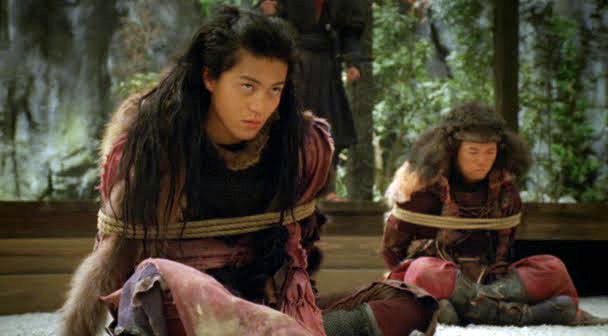
Born the second son of the Hatakeyama family, Naomitsu  (Oguri Shun) had long accepted the fact that his  rank in life was lower than that of his older brother Nobutsuna, (Ikeuchi Hiroyuki), who's the heir and future leader of the family. As a child, he knew better than to challenge his brother's authority, he knew early on that his duty was to serve his family with utmost loyalty. As a grown up, he sought neither power nor glory; to him, happiness meant living a life of obscurity and having enough freedom to do as he pleased.


Naomistu went  about his life oblivious to politics, he couldn't be made to care about wealth or be bothered to find out how much influence he could wield. He was blind to the malicious intent and ambition of others around him, and so when the shogun (Kenichi Hagiwara) unexpectedly  issued a decree declaring the marriage to his betrothed Ako (Shibamoto Yuki) a condition precedent to obtaining the title of  provincial deputy, Naomitsu failed to anticipate the trouble that the said edict would bring on to his family.

The shogun's announcement set off a major controversy, leaving Naomitsu at a loss as to how to allay his older brother's fear of being deposed of his position as head of the clan. He sincerely tells Nobutsuna that he's not interested in obtaining gold or the status of deputy. But all is for naught as the latter's mind is slowly filled with lies told by their adopted brother, Sakuramaru  (Tanaka Kei), who's already made his own bid to acquire the power and position held by the Hatakeyama family. Playing Iago to Nobutsuna's Othello, Sakuramaru incites the insecure older brother to betray his only brother; forcing Naomitsu to flee with Ako into the woods where they come across the bandit Tajomaru (Matsukata Hiroki).


Drawing inspiration from Akutagawa Ryunosuke's short story In a Grove, writers Ichikawa Shinichi and Yamamoto Mataichiro's Tajomaru stands as a brave yet clumsy attempt at doing a fresh and innovative take on the original story. What the screenplay does is, it fills in the events that occurred prior and  subsequent to the discovery of the body in the woods and runs [amok] with it-- thereby producing an alternate account of what transpired whilst providing a backstory to the now legendary bandit from which this movie takes its name.

As a period piece, Tajomaru excels in enticing viewers with its grand scale and lavish production, unfortunately, the plot and execution of it all makes it more of a drab assembly of clichés and contrivances than a brilliant reinvention of a classic tale. For while the original material concerned itself with seven varying accounts told in the course of a murder investigation, Tajomaru merely makes use of certain elements in the literary piece and reproduces key scenes in the Akira Kurosawa adaptation, Rashomon, to create a spin-off with a storyline that can be found in no less than a dozen samurai epic films. The fact that it's unoriginal is not even the main issue, the problem lies in its  lukewarm rendering of classic themes such as love, betrayal and revenge, and its writers' seeming inability to recognize when to stop introducing twists so ludicrous and fanciful that it makes the whole thing unintentionally laughable.  


Tajomaru gives its viewers the initial impression that it's a throwback to sword-fighting films of old; it briefly introduces the characters and their motivations, hints at an impending conflict, and generally sets the stage for its hero to fall to the depths of despair in order to subsequently rise up to reclaim his honor and dignity. Its first forty minutes is pure cinematic gold given that it has all the hallmarks of an enduring tragedy wherein a simple misunderstanding breaks the tenuous equilibrium that exists within a family.  That being said, it's set up  rather nicely, as the movie opens with a simple voice over, laced with a melancholy that only comes with narrating things past. It's complimented by breathtaking cinematography that captures the changing of the seasons, for as spring slowly gives way to fall, two brothers are seen to compete to gain one woman's hand in marriage, furthermore, a trusted servant reveals himself to be the snake that he is. Its overall look and tenor evokes that of a Shakespearean tragedy, but sadly, the extent of its hook ends in the setting of its lush landscape and intricately designed costume pieces, because  beneath all that style and gloss is a story that never really managed to make sense of what genre it wanted to belong to, such that its focus kept on shifting every quarter of the film.

The movie is layered with conflict-- it has a virtual blitzkrieg of dramatic events that would lead anyone to believe and anticipate that the protagonist would eventually be given the means and opportunity to seek revenge under a new identity. That in itself would have sufficed, the rub is that as one dramatic event was followed by another, the more far-fetched the story became and the less satisfying was the outcome. There were too many elements in it alien to the story; the pop-rock Robin Hood-esque montage and rap sequence negate the tone and gravity established in the first half of the film, while a last-minute twist merely serves as an overture to a nonsensical trip to hell and back, which was mere padding  for the story. And it literally is a trip to "hell" and back. 


The inclusion of a modern track in the middle of the film would not have been so out of place if this movie had the same flighty humor as director Nakano Hiroyuki's Red Shadow: Akakage or the "ninja-splatter punk" style of Kitamura Ryuhei's Azumi where a freakishly made-up Odagiri Jo played a bishonen assassin. But Tajomaru is not the type of movie to fall under any of the aforementioned category. It presents itself to be more than what it actually is---it's supposed to be this serious film based on a classic story but in reality, all it is, is a melodramatic film that's so turgid, one can't wait for the closing credits to roll on screen. 

Perhaps the biggest shortcoming of this movie is that it has a hero that's content to just pander and coast along without any predetermined goal, direction or zeal. Naomitsu does not have the grit and heart typical of heroes  in this genre, he's easily disheartened and weak without his lady love. He's no Edmond Dantès or Crisostomo Ibarra, that's for sure, as he spends a good amount of the movie looking hurt, betrayed and intensely sissyfied despite the dreadlocks and the fur overcoat. Oguri Shun tries hard to lend credence to such a pathetic character, looking exaggeratedly forlorn and wistful, and at times mad with rage and comically homicidal. He sobs, he snarls in anger, looks dejected and even throws his head back to wail at the sky and survives  what appears to be at least a 12-ft jump before finally deciding take action against the enemy. There's very little character development in this production, so the rest of the cast can't be expected to do any better-- Ikeuchi Hiroyuki plays Nobutsuna with a permanent look of dissatisfaction on his face, showing no hint of affection or consideration for his younger brother contrary to the portrayal of his child version; Shibamoto Yuki looks resplendent in colorful silk robes but her turn as the defiled and self-sacrificing Ako makes for one beleaguered heroine that serves no purpose but to turn this movie's hero into a whimpering idiot. And even though Tanaka Kei gets to play a marvelous villain, the conclusion to the sword fight and his dying words in the end only emphasize how unbelievably moronic this movie turned out to be.

So if you're planning on watching this, be sure to remember the following:  (1) lower your expectations;  (2) have a good laugh; and (3) be done with it. Don't lament having wasted your time and money on it. 
Read More

Thursday, June 10, 2010

MW


A leak from a secret foreign military facility that stores a deadly chemical agent kills off the inhabitants of an island and forever alters the lives of two boys who survived the said incident. In commemoration of the 80th year of the kamisama of manga, brace yourself  for yet again another disappointing adaptation of a Tezuka Osamu classic---this time in the form of the gekiga-inspired  MW. If you thought that 2009's Astroboy bore little or no resemblance to the essence of the robot boy with the cow lick and go-go boots that you knew and loved as a kid, then brace yourself for another travesty as the people of Amuse Soft Entertainment and Studio Swan bring you a sanitized version of the serialized tale of a cold-blooded killer and his religious confidante.

I must confess that I took one look at the cast of this movie and made up my mind to see it. I was already 30 minutes into watching it when I decided to stop, get hold of a copy of the manga and familiarize myself with the story. There was just something amiss about it and I couldn't shrug off the feeling that I was missing chunks of the narrative, so I had to go and see for myself if there was something to it. Lo and behold, I wasn't imagining things---there really was more to it, sadly, a lot of things didn't make it to the big screen. 


The movie begins in the midst of a cover-up in Okine Mafune Island where nerve gas MW leaked from a secret U.S. military facility and killed a majority of the island's inhabitants instantaneously. To spare itself from a public relations nightmare, the Japanese government, in league with the American government, embarked upon a conspiracy to wipe out any indication of the accident. Within hours, the whole village was torched, and helpless civilians were gunned down and buried in mass graves. Relatives of those massacred were later bribed to occupy positions in high places and the island was slowly re-populated. It's as if the incident never happened and anyone who can attest to the existence of MW and it's dangerous effects were either long gone or over it---all, but for two boys who escaped to the mainland.

Sixteen years later, survivor Yuki Michio (Tamaki Hiroshi) grows up to become a shrewd and successful investment banker who, unbeknownst to most, is suffering from the side effects of the MW gas he inhaled as a child. Calm and collected, he goes about committing heinous crimes against the people who conspired to cover-up the incident in Okine-Mafuno Island under the pretense of seeking justice, all the while indulging his insatiable need to kill. The only person who knows that he's leading a double life is fellow survivor, Garai Yutaro (Yamada Takayuki), who sought solace in the Catholic faith. In him, Yuki confides his evil thoughts and deeds knowing that his childhood friend would dare not betray him, much less break the confessional seal.


Owing Yuki a debt of gratitude for saving his life, Garai becomes an unwilling accomplice to the crimes perpetrated. But Yuki's killing spree doesn't go unnoticed, as an investigative journalist (Ishida Yuriko) begins to piece together the common denominator for the seemingly random series of crimes. Also closing in is a detective (Ishibashi Ryo) who begins to suspect Yuki's involvement in a recent kidnapping case that played out in Thailand. Now, Garai has to make a choice between doing what's right or doing right by his best friend as it turns out that all Yuki ever wanted was to find the MW and take the whole world down with him...

Packaged as an action movie, Director Iwamoto Hitoshi's (Nobuta wo Produce, Tatta Hitotsu no Koi, Jyou no Kyoshitsu) big screen adaptation of the Tezuka classic has its fair share of chase sequences and narrow escapes. MW has all the makings of a decent crime/espionage thriller with bullets flying, a hidden chemical warfare agent, and an ever increasing body count but ironically, none of the intrigue and complexities that made the original material a work of notoriety. Screenwriter Oishi Tetsuya, who also handled the duty of bringing Death Note to the silver screen, devotes too much of the movie's running time establishing Yuki as a criminal mastermind while neglecting to explore his often twisted, and beguiling relationship with Garai. Stripped of any political underpinnings or character exposition, the movie ended up cutting way too many corners in adapting the manga and was particularly careful not to dwell on the darker, more sinister elements of the story. In doing so, viewers who are unfamiliar with the original work remain unaware of how much of a psychopath Yuki is, nor will they even begin to appreciate the significance of Garai's sacrifice.

All I want is you beside me. No more terrible crimes.
In the manga, Yuki and Garai were not just fellow survivors or best friends, they were lovers. They were two people bound together by one traumatic experience; both were haunted by one incident that pretty much changed their lives forever. No two characters could have possibly been more diametrical in both physique and demeanor-- one is a man of the cloth, while the other a sexual predator; one subscribes to rape and murder, while the other believes himself doomed to suffer the fiery fires of hell. Tezuka's Yuki is beautiful, charismatic and irresistible to both men and women. He kills people without remorse and doesn't think twice about eliminating anyone who gets in his way. Garai, on the other hand, is a devout Catholic and a loyal friend. Despite doing his best to sever ties with Yuki, he always finds himself unable to refuse the latter's invitation to share the same bed. It's a dysfunctional relationship that knows no bounds, as a seemingly amoral and unfeeling person like Yuki possessively holds on to Garai and a supposedly just and upright man like Garai protects Yuki from the authorities. It's such a shame that the movie barely hints at this kind of devotion between them.

Most of the scenes that give a passing nod to the manga can be easily overlooked; they don't even make much of an impact. For instance, the part wherein Yuki dons a nun's habit while making a mock confession before Garai could easily be dismissed as pure whimsy, when in fact, it's demonstrative of Yuki's pathological behavior (Yuki supposedly hails from a well-known Kabuki family and is therefore skilled in impersonating women, in particular, his victims). The scene where a worried Garai plainly tells Yuki to stay with him implied the existence of a more intimate relationship, but the writers felt the need to undermine the same by later referring to Garai as Yuki's "favorite toy". These are but a few instances wherein a slight of hand could have been used to make the movie closer to its source material, but intentional or not, things were never really placed in their proper context.


Casting Tamaki Hiroshi as the charming and devilish Yuki next to Yamada Takayuki's somber Garai was an interesting choice. Both possess the physical attributes that make for a startling contrast to the two distinct characters of MW-- one being tall and slim, while the other short and stocky. It's quite unfortunate that Tamaki comes off cold and stiff as the manipulative Yuki when the character was written to be deceptively personable. He plays it straight and smart with hardly any sign of mental imbalance except for his bulging eyes, which is fine, really, except that it's a far cry from the Yuki who's supposed to be a cross between Brett Easton Ellis's American Psycho and Patricia Highsmith's The Talented Mr. Ripley. Yamada does slightly better by looking sufficiently tormented and morose, but then again, without the right back story, he ends up looking dull and pathetic.

Overall, MW is the Japanese equivalent of your basic Hollywood action movie where plot and character development take a backseat to expensive set pieces, numerous aerial shots, overseas location shoots, and even foreign bit players. The movie starts off with a bang and ends with a whimper as much of the build-up in the beginning is laid to waste as events become too incredible to ignore. It's good enough for movie night but it somehow leaves you with a feeling that you were shortchanged and that there should have been more to it. In this regard, the manga should serve as a pretty good companion piece. 

---------------------
Photo Credits: Ki Image Gallery AsianMediaWiki/MW
Special thanks goes to the good people of Random Scans and Kickthekitty for their wonderful scanlation work and for providing links to Osamu Tezuka's MW.
Read More