Showing posts with label Japanese Drama. Show all posts

Sunday, August 26, 2018

Kaito Yamaneko (2016)


Tonally defective yet thematically complex, Kaito Yamaneko has this skittish energy that runs counter to the weightiness of its socio-cultural commentary resulting in one bifurcated mess of a series. It lends itself to sharp changes in mood, characterization and storytelling---so unnerving that even a Kamenashi Kazuya apologist would have trouble defending it. Unleashing a cascade of what appears to be utter nonsense amidst its bipolarity, it is consistent in its inconsistencies and yet curiously steadfast in advocating the identification and practice of core values even as it lumbers wearily to its befuddling conclusion.

It's easy to dismiss it as a loonier version of those page to screen adaptations of suspense thrillers that went off kilter (e.g. Bloody Monday and Jiu) but on closer inspection, it's more like the jdorama that has something to say but doesn't know how to say it.... or does it? The show in itself tackles too many social maladies and references historical events pertaining to Japan to be brushed off as whimsy or coincidence. Kaito Yameneko is zany, offensive and culture-specific, which leads this particular reviewer to believe that all the insanity and shaky tirades are intentional and should be taken as no less than satire disguised as pointless, childish entertainment.


Much like GTO and Gokusen, the main character of this series is someone who acts with righteous zeal and whose loud, fervid demeanor belies a capacity for brutality. Made out to be extremely abrasive, the great thief Yamaneko (Kamenashi Kazuya) is not exactly a lovable character---cartoonish to a fault, he wets his pants, sings out of tune, and wears flip flops during winter to air out a chronic case of athlete's foot. But make no mistake, he's out on a mission. As rogue agent turned ferocious ally of justice, he's out to take down a legendary crime boss and leader of the country's shadow government, Yuuki Tenmei. In the process, he exposes corruption and wrongdoing, steals from the rich to give back to the poor, deriding both the offender and victim for lacking in principles and  being empty at their core.

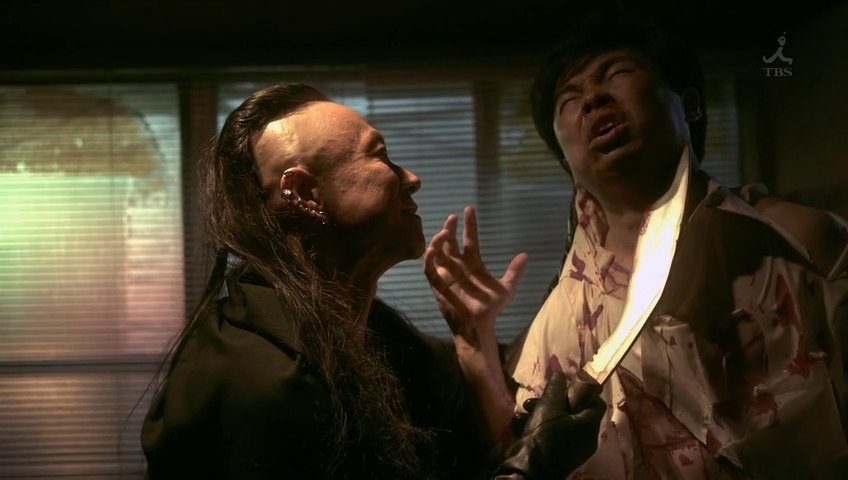
Using the Stray Cat Detective Agency as his cover, Yamaneko tackles each case with the help of a kindly den mother (Otsuka Nene), a talented high school hacker (Hirose Suzu) and a reluctant but gullible magazine reporter (Narimiya Hiroki). Secretly working alongside them is his former handler, turned police detective, Sekimoto (Sasaki Kuronosuke), who obstructs the investigation every time detectives Kirishima (Nanao) and Inui (Ikeuchi Hiroyuki) get too close for comfort. It's all fun and games with ridiculous heist sequences until someone dies, a mysterious woman with a vendetta appears and the villain manifests himself in a spindly life support system helmet. When Yamaneko comes face to face with a ruthless mercenary known as the Chameleon, a modicum of danger and intrigue is introduced to the series only to have the tomfoolery resurface with renewed force.


Kaito Yamaneko is frustrating to watch as it shifts gears from one moment to the next without prior warning. Even when the chips are down and blood is spilled, the show makes room for a light-hearted intermission. Much like how socio-anthropologists and cultural psychologists write about theories on the search for identity in Modern Japan, the show is continuously at odds with itself, unable to determine whether it's supposed to be a slapstick caper or a wannabe political espionage thriller. The action sequences are likewise plagued with this schizophrenic touch, some being decently choreographed fight scenes, while others resembling a mix of the hammy 70s Batman scuffles with a little bit of the Three Stooges' smacks, slaps and kicks.

Replete with annoying shenanigans and cruel impassioned sermons, it can grate on the ear and try one's patience but at the same time one can also tell that it's intended to reach a particular audience. It makes mention of issues particular to Japan and paints a rather dim and sad picture of a society wherein the youth pass on the blame and do not take responsibility for their actions, where parents betray and give up on their children and politicians view their constituents as dumb sheep fit to be manipulated. The antagonist is virtually a phantom that is symbolic of a rigid but obsolete economic and social system that once provided wealth and prosperity but now struggles to cope with changes in the global age. The hero, being representative of a value system of a bygone era, is someone who is of equally questionable relevance and lost in the fray.

Kaito Yamaneko is the type of show that can be deconstructed in a number of ways---it has lofty ideas beneath a barrage of distractions, probably designed to soften its message and make it agreeable to a wide audience. Is it interesting or entertaining enough to pass off as a light, harmless series in the same vein as a Lupin III live action adaptation without need of figuring out the context in which it was made? Sadly, it's not. It's too jarring for a serious viewer and too abstruse for a casual one.  


RATING: 
SHARPLY BIPOLAR
TONE-DEAF SINGING
INTENDED SOLELY FOR JAPANESE AUDIENCE
LOOSE COMMENTARY ON JAPANESE SOCIETY

Read More

Saturday, August 11, 2018

Scatterbrained Musings


So what have I been watching?

Like any other jdrama viewer, I tend to watch an ongoing series from time to time. Black Pean was a show that I watched religiously for weeks during its 2018 spring release until I found myself one episode short of completing it. After the penultimate episode, I just couldn't muster the interest to see it. It was just too repetitive for my liking and the central debate posited about human skill versus technology did not only feel moot and academic, but it was driven up to extreme illogical reasoning. I also couldn't shake off the feeling that the revenge plot was borne out of a misunderstanding, making that storyline one empty, dissatisfying tidbit. Of course, I could be wrong about this but I'll find out eventually if and when I finish it. 

In contrast to the disappointment that was the ratings juggernaut for the spring season, Aino Kekkon Soudanjo turned out to be an amusing, quasi-musical oddity. I personally found it to be quite entertaining and I attribute this to the fact that I saw it without any expectations whatsoever. Furthermore, actor Yamazaki Ikusaburo was rather exceptional in keeping the same level of energy in each episode, regardless of his co-stars' performance and no matter how silly the scenario.

Another welcome surprise was Ossan's Love. As the lengthier remake of the television special bearing the same title, the series had more meat in its story, in my book being the first BL story to get mainstream treatment with Tanaka Kei and Hayashi Kento playing the male leads. With there being more LGBT[Q] characters in Western television than ever before, jdramas have slowly followed suit featuring members of the said community in a more positive light. They've been represented well in dramas like Nigeru wa Haji da ga Yaku ni Tatsu, Kuragehime and Tonari no Kazoku wa Aoku Mieru---a far cry from the tortured and beleaguered characters in Last Friends, Sunao ni Narenakute and progenitor, Asunaro Hakusho. There's one more season to go, but for this year, in my humble opinion, the best of the lot would have to be NHK's Joshi teki Seikatsu. Brazenly realistic, touching without being melodramatic, the mini-series has a rather progressive take on the life of a transgender woman.

Opting to dig into my drama archive, I likewise saw Anata no Koto wa Sorehedo,  which is about an extra-marital affair pursued by childhood acquaintances. The show chronicles how the betrayal and the lies impact the marriage of two couples but the supposed love which triggers the illicit relationship does not take as expected. This was a terrible misstep for the likable Haru, who was outperformed by Naka Riisa at every turn. Programs like these are often regarded as guilty pleasures but this series felt more like a tedious viewing exercise.

Rounding off this list is the Japanese drama remake of the 2016 Korean series Signal. A crime thriller with a bizarre twist courtesy of a portable radio transceiver, the premise appears to have been culled from the 2000 movie Frequency but it slowly establishes a difference agenda, playing with the idea of the possibility of changing events in the past and how such changes can affect the future. Detectives from different time periods converse as the clock strikes at 11:23pm, encouraging each other not to give up hope but I was rather of the mindset that the show was headed towards a dismal conclusion. Fast-paced and engaging, it's bogged down by histrionic performances and an ambiguous ending.

Will I be writing full reviews of any of the foregoing?

I really can't tell. Right now, the first order of business is to put my Kaito Yamaneko and Meishi Game reviews to bed. I'm trying to streamline the reviews and cut down on screencaps so this might take a while.

Read More

Thursday, June 28, 2018

Miss Sherlock (2018)


Miss Sherlock reimagines Arthur Conan Doyle's beloved investigative tandem as an incongruous pair of women solving mysteries and preventing crime in modern day Tokyo. The latest in a long string of interpretations, this HBO Asia/Hulu presentation makes plenty of references to the original works and endows its characters a certain degree of similarity, but altogether feels like a different show on its own. Top billed by familiar faces, and produced with enough style and care, it's one of those series that you would expect to love but somehow don't.  

There's just something amiss and faulty in its execution---so while there are amusing alliterations and superficial elements to it that remain recognizable, the core element, which is the partnership between Holmes and Watson, gets lost in the gender and race alteration. The series tries to provide a new take on the relationship but the cultural transposition somehow makes the bond between the two less evident and unconvincing. As a result, you have female counterparts that are like Holmes and Watson but they're not Holmes and Watson per se.


In this version, the titular character Sherlock (Takeuchi Yuko) is a female consulting detective working for the police department under the authority of Lt. Reimon Gentaro (Kenichi Takito). Highly intelligent with a petulant air about her, she has a reputation for being rude and disagreeable but her ability to piece together information and crack cases is matched by no other. Comprising the other half of this sleuthing duo is Tachibana Wato (Kanjiya Shihori), a doctor who just returned from a volunteer mission in Syria, currently in search of a new direction in life. Polite and well-mannered, she finds herself sharing a house with Sherlock and tagging along each adventure under the pretense of keeping her eccentric flatmate in line. Together, they face danger and solve mysteries, forging an unlikely friendship that Sherlock keeps denying the existence of until the very last minute.

The series has three (3) standalone cases that involve a missing bride, a vandalized artwork in public exhibition, and a family curse that allegedly compelled a mother to drink her child's blood. The remaining five (5) pertain to a series of crimes instigated by one person who goes by the moniker Stella Maris, otherwise known as The North Star, who guides wayward individuals to their true calling.

Keeping up with the times, Miss Sherlock updates the business of the main adversary from being the leader of an organized crime syndicate to charismatic head of a full blown extremist-terrorist group. The perpetrators are victims of abuse, social misfits and misguided social justice warriors that no longer respond to logic or reason, making each encounter with an adherent unpredictable and dangerous for Sherlock and Wato. 


Giving Sherlock's nemesis the ability to alter people's thoughts and perceptions, gives the character a new passive-aggressive slant. To this extent, the show explores the thesis on how brain trauma can turn people into violent criminals and how emotionally scarred individuals can be made vulnerable to manipulation and suggestion. The downside to it is that the crimes as committed lacked refinement, most of them, impulse-driven. In effect, the criminal mastermind prompts people to act without making room for exigencies, thereby guaranteeing the failure of each mission at the hands of our dedicated duo. 

The manner of the commission of the crimes and the resolution of certain puzzles also don't hold up to scrutiny despite the laborious set up of certain scenes. For instance, a weaponized smart pill is only lethal up to the time of the carrier's next bowel movement, the specs to a nuclear warhead written in blood on the wall of a prison facility would have long been erased using bleach as a cleaning agent, and how spreading a virus without discussing the mode of transmission from the infected host comes off as a huge contrivance, particularly when he's dispatched in a wide open space without incident.

Even without nitpicking at the cases, Miss Sherlock has one major flaw---and this is its inability to translate the strength and complexity of the relationship of the iconic characters from which this series is based on to the present adaptation. This plaid and kimono silk incarnation is built on an unequal  and whimsical partnership, wherein Sherlock is the star and Wato plays second fiddle. A recent interview with actress Takeuchi Yuko even likened Sherlock's fondness of Wato to that of a pet. [1] Overall, the writers did not take into account the change in the dynamics of this friendship, with the script failing to convince viewers of the natural rapport between the leads. The gender reversal automatically affects the constitution of what is supposed to be the basis of female bonding, while the cultural relocation itself hinders characters from being too open and expressive. The character of Sherlock in this setting is too much of an anomaly, she sticks out like a sore thumb. Wato, in theory, exists to make her seem less severe and accessible but unintentionally comes off as too submissive and feeble. If the show comes back for a second season, the first thing that they should fix is the existing disparity in the roles assigned to these two characters, otherwise it will look inferior next to BBC's Sherlock and CBS's Elementary.


RATING: 
GENDERBENT VERSION
HUMDRUM CASES
POOR RAPPORT BETWEEN LEADS
EXCELLENT PRODUCTION VALUE


Read More

Tuesday, June 12, 2018

Love Rerun (2018)


Love Rerun serves up a nonlinear narrative to an otherwise traditional and cliché-ridden love story about a girl, her unrequited love, and an ostensible do-over in the romance department. It basically plays up the notion of second chances and the futility of clinging on to a past love amidst a quagmire of work-related issues and awkward living arrangements. Fully showcasing its shōjo manga roots, the set up includes the drastic transformation of an insecure, mousy girl into a stylish beauty with a case of selective amnesia as the trigger for the character conflict. Sharing the same giddy and hopeful qualities of Proposal Daisakusen, viewers get to witness and revel at the main character's first blush of love, but it has none of the emotional nuance or dimension of Mou Ichido Kimi no Propose to elevate the flimsy material. 


Minami Sayaka (Nakamura Anne) has been in love with her childhood friend, Sagisawa Ryosuke (Otani Ryohei) for as long as she can remember. Single, about to turn thirty (30), and having absolutely no experience in love, she makes up her mind to confess her feelings to him on her birthday, hoping that he would see her as more than a friend.

Before the intended date, she closes her eyes to sleep, only to wake up in a strange apartment, in clothes that she would not customarily wear and in such a fashion that she could only dream of. Shortly after, a man enters the room telling her to leave as soon as she finishes packing her things. She rushes out of the building in a dazed state to discover that it's three months later, she got promoted at work, was cohabiting with a man named Machida Shohei (Furukawa Yuki),  and that the said relationship was over. Apparently a lot of things have changed but she has no recollection as to how and why she got in her current state.

Utterly clueless with nowhere else to go, Machida agrees to let her stay with him until she regains her lost memories. She's back to pining after her precious Ryo-chan but this stranger of a man, who plays her reluctant host, has the inherent ability to move her in ways that she can't ignore.


Love Rerun opens with this fairly staged story hook that keeps viewers engaged and curious about what happened in those lost three months. What came about Sayaka's love confession? How did she get to be in a relationship with a younger co-worker? And more importantly, what caused them to break up? The series is at its best when it ties in Machida and Sayaka's past encounters to present events, making the whole affair a rediscovery of love as much as a perplexing breakup.

The missing pieces of the puzzle are rendered through flashbacks so sincere and tender that it's without question how Machida won Sayaka's heart. The fact that he knows the right things to say to prod her into action and takes notice of little things make it fairly obvious that he cares deeply about her but the reason why he keeps his distance is the show's biggest conundrum. Unfortunately, whatever intrigue sparked by its first half would slowly devolve into a circuitous array of hurdles as the main characters yield to misunderstanding and interference from supporting characters who are too quick to have a change of heart. It's a long, frustrating road towards a foregone conclusion and a disappointing reveal of the cause of the split---which is nothing that a mature and committed couple can't handle after a serious discussion.


RATING: 
MYSTERY BREAKUP
NONLINEAR NARRATIVE
FICKLE CHARACTERS
CORNY ENDING

Read More

Saturday, February 18, 2017


As far as holiday features go, Watashi ni Unmei no Koi Nante Arienaitte Omotteta is like that Hallmark romantic movie that one would occasionally indulge in and actually enjoy without the need to over analyze things. Sweet, warm and comforting in its predictability, it ticks all the boxes needed for a satisfying romantic comedy, right down to that premature wedding proposal, under the sponsorship of a popular jeweler with a flagship store in Motomachi. It's a neat and uncomplicated love story, anchored by charming performances from its lead actors who exude a natural rapport, making the supposed transition of the characters from friends to lovers a seamless development.

A delightful, romcom puff piece, this television special has characters that meet cute, fall in love, and surmount superficial conflict to presumably live happily ever after, under the warm glow of a Christmas tree. All things considered, it doesn't introduce anything new to the genre but it's cheeky enough to acknowledge its own trappings and cute enough to tide over any viewer who's experiencing heavy melodrama fatigue.


Shirano Riko (Tabe Mikako) is a career-driven, love game creator who gets commissioned to design a mobile game for an app development company that's looking to expand its female market. She meets the curt and condescending CEO, Kurokawa Seichiro (Takahashi Issei)---who initially ridicules the concept of cultivating unrealistic female fantasies but later relents to changing his attitude and approach, under Riko's guidance, to capture the attention of project leader, Momose Haruka (Oomasa Aya).

Riko sets Kurokawa to work, schooling him in romance inducing "patterns" found in trendy dramas and encouraging him to mimic and test out the behavior of the stereotypical male characters in her games in order to to determine which one would set Momose's heart aflutter. In acting as his dating guru and wingman, they become fast friends. They start talking about things that matter in between planning their next course of action as they continue on with the love and relationship mentoring.

When Kurokawa swoops in with impeccable timing to save Riko from an embarrassing situation, she becomes acutely aware of her growing feelings for her timid mentee. She's taken by surprise and simultaneously torn when all their preparations yield a positive response from their once oblivious  and elusive co-worker. 


The setup for the show is nothing new but writer Oshima Satomi makes clever use of poking fun at trendy dramas and shoujo manga tropes without necessarily dismissing the reasons behind why they're so popular to female viewers and why such story devices endure. All the references to male stereotypes and variations to certain scenarios are done in good humor with the kind of self-awareness  and self-deprecation that acknowledge their absurdity. But no matter how repetitive or contrived they may be, the show ultimately rises to the defense of such characters and situations, recognizing their power to enthrall and inspire, as can be gleaned from Riko's rebuttal of Kurokawa's flippant attempt to ridicule her work at the beginning of the program.   

Watashi ni Unmei no Koi Nante Arienaitte Omotteta pays reverence to the romcom formula by going through the same motions of any such love story, selling the magic of romance even as it attempts to temper the fantasy. The show does not veer away from audience's expectations, opting for the most conventional ending, with the show's last fifteen minutes providing the most clichéd resolution to an otherwise decent and well done romcom.

The moment Riko blurts out her feelings, the show goes on autopilot to reach the anticipated ending. Running through decorated, tree-lit streets, across a famous shopping district, a lighted ring box would await our once loveless heroine. It's not a question of whether or not Kurokawa and Riko get together (because they do) but how they get together that will truly capture your attention. There's a lot to love about the said journey for the show excels in building upon light moments with honest dialogue to carry the scenes. The more elaborate and comic attempts at initiating romance are likewise memorable, of which there is Kurokawa's hilarious yet unsuccessful attempt at emulating character types and an all-night viewing marathon of a capsule, 90s-inspired trendy drama with Riko providing live commentary as an added treat. It's not perfect but it's good enough, in terms of viewer satisfaction, it's hard to find fault in it. 


RATING: 
ENJOYABLE IN ITS PREDICTABILITY
CHARMING LEADS
CAPSULE TRENDY DRAMA
POKES FUN AT SHOJO MANGA TROPES


Read More

Friday, December 30, 2016

Fragile (2016)


Japanese medical dramas are often an indictment of the country's health care system and in this particular case, Fragile does not veer away from the norm. It's not about medical marvels or unusual cases, it doesn't focus on one person's acquired skill or acuity but instead prefers to emphasize the need for data collection and analysis. It does take a page off the Doctor X playbook in terms of throwing shade at the apparent incompetence of health workers who either cut corners or get too complacent with their work, but it also shares the same flaw as its popular counterpart in the sense that its main character is not half as interesting as the other characters around him.

Fragile adds a curmudgeonly pathologist to what appears to be a growing roster of ace doctors who could do no wrong. Kishii Keichitaro (Nagase Tomoya), is the lone pathologist in a university hospital full of doctors in a rush to treat patients without obtaining a conclusive diagnosis. He defies convention by refusing to don a white coat and foregoing idle pleasantries, thus drawing the ire of medical practitioners with his arrogant, holier than thou attitude of declaring his findings to be 100% correct and unimpeachable. Such assertion, though closer to the truth than, say, a surgeon that never fails, does very little of convincing his colleagues to heed his advice and exercise caution, resulting in a number of mishandled medical cases exhibited in the show's 10-episode run. 


The series delves into the unacceptable occasion of having doctors dismiss serious medical conditions as minor ailments, erstwhile prescribing the wrong medication for ordinary ailments and diseases. Just about every doctor in the show gets it wrong, except of course, for the maverick pathologist who insists on finding the underlying cause of the patient's condition.  It's not exactly House M.D. but it is a medical show that champions clinical pathology and its role in medical diagnosis and treatment.

Personality quirks and righteous speech aside, Kiishi, as played by a dour Nagase Tomoya, does not make for a compelling lead character. The show extols the commitment of Kiishi to his profession but the jdrama simply gets more mileage when the story is told from the perspective of the patients who fall victim to the system. Very little is said or known about the man that heads the said pathology department aside from the given information that he was an attending physician  prior to being mentored by a naughty senior pathologist (Kitaoji Kinya) and that he once had a physical relationship with his former classmate (Koyuki), with whom he has forged a friendship. 


Far from being the voice of reason or the heart of the show, the series conveniently wanders away from Kiishi and rests it sights on his young team composed of an efficient lab technician named Morii (Nomura Shuhei) and a trainee doctor named Miyazaki (Takei Emi). They're the ones that have sufficient story arcs wherein the former is faced with the opportunity to abandon his present station in pursuit of a lost dream, while the latter is forced to reassess and shed old habits to suit her chosen discipline. Furthermore, it's their exposure to the patients that taps into the emotional core of these harrowing stories of negligence and lack of empathy in the medical field. 

Fragile hits its sweet spot when it manages to convey the human interest story within its quasi-medical procedural shell. The most memorable cases are the ones that hew close to reality and played less for dramatic effect but more for their honesty. The most powerful scenes involve---a quiet moment that passes between two young men contemplating their respective fates; a young woman frantically flipping through a notebook trying to offer information on procedures performed on a baby in need of medical attention; and a medical representative privy to the fact that the trial drug she's been peddling is not a miracle cure. 

The show doesn't skirt around the fact that patients die and doctors who are at fault do not get demoted or get slapped with malpractice suits. It doesn't delve into the science of pathology but the concept and principles behind it, which makes the series easy to watch but hardly essential viewing. Kiishi's platitudes are kept to a minimum and the show pretty much does away with saves or surgeries akin to a Hail Mary pass. Miyazaki ends up doing way too much work for a trainee to the point of interfering with protocol but accuracy and realism rarely go hand in hand with these type of shows anyway. 


RATING: 
ANOTHER BLAH ACE DOCTOR 
SUPPORTING CHARACTERS HAVE BETTER STORY ARC
NO MIRACLE SURGERIES
TRAINEE PATHOLOGIST DOES EVERYTHING

Read More

Sunday, November 27, 2016

Tenshi to Akuma (2015)


In Tenshi to Akuma, a female cop and a private lawyer, working under the auspices of the prosecutor's office, make up an ad hoc division of the police charged with reviewing unsolved cases. They go over the facts and sift through witness testimony in order to identify and facilitate the filing of criminal charges against the actual felon who has, for a time, eluded apprehension.

Makita Hikari (Gouriki Ayame) is a rookie officer, who was initially placed on active duty in consonance with a national program designed to increase the participation of women in law enforcement. After a short and unremarkable stint in homicide, she finds herself reassigned to doing clerical work, demoted to shelving case files in the Unsolved Cases Unit. Joining her as a deputized officer for the prosecution is Chajima Ryunosuke ((Watabe Atsuro), a sly and unctuous private practitioner who initiates the reinvestigation of cold cases on file. Together, they make a rather awkward, not to mention questionable, crime-solving duo with the young wide-eyed optimist insisting on swaying people to do the right thing and the cynical yet seasoned member of the bar electing to offer a plea bargain at the drop of a hat.


The curious thing about this show is that it's not a legal drama nor is it a crime procedural---the series is in fact built on amateur sleuthing through chronic, off-site interrogations of persons of interest. Unlike Cold Case: Shinjitsu no Tobira, the characters in this series are not driven by a new lead or the discovery of new evidence to reopen investigation, instead the show takes stock of select cases which fit the overarching concept of portraying how human beings can be duplicitous creatures. For this purpose, it concerns itself with uncovering the truth beneath the lies and distinguishing the so-called angels from the demons, calling attention to the unofficial use and status of plea-bargaining in the Japanese criminal justice system by showcasing the benefits and potential dangers attached to such practice.

Crafting stories around proposed and/or pending legislation is one unique feature of Japanese television. Whenever a change in government regulation is introduced or an amendment to the present economic or judicial system is proffered, one can more or less expect a corresponding drama series using the said controversy as its focal point. Productions of this sort belong to a broad spectrum---the really good ones can bolster public debate and discussion, while the crummy ones resort to fear mongering and blatant propaganda. Entries in this genre range from the highly fictional (Majo Saiban, Soshite, Dare mo Inaku Natta) to the profoundly moving (Hagetaka, Tetsu no Hone) and this is something that you can only find out upon actually watching the series.

Due to its episodic format, Tenshi to Akuma is middling in comparison to social dramas that herald change and call for introspection. The series just doesn't have a definitive point of view or insight on criminal plea bargaining. A majority of the episodes appear to favor plea bargaining by producing a favorable outcome to every scenario wherein past crimes could not be prosecuted without soliciting the cooperation of key persons involved in the act sought to be punished. On the flip side, it also allots time to present the lack of transparency in plea bargaining negotiations and the derailment of justice brought about by securing false testimony, but these episodes come out weaker despite being the main attraction of the story arc. Furthermore, the creation of the special division makes no sense, especially when the proponent has bones in his closet and the supposed muscle of the team is a skinny young woman with no field experience flashing a badge. 


What's good about it is that the series presents an assortment of cases that provide a cache of differing means, motives and opportunities for the commission of the nine crimes investigated. The guesswork is fair and the best episodes involve sympathetic characters driven by self-preservation and acted without premeditation. The top half of the series is serviceable and mildly intriguing with men and women equally represented in their capacity for violence and display of malice.There are a few unexpected twists and a good deal of misdirection for certain episodes but they don't work as well if the viewer is keen on checking the runtime or spotting familiar actors.

Needless to say, one will watch this show because of the cases and not because of its main characters for there is nothing particularly dynamic about the partnership. Makita and Chajima start off as two strangers that have to temporarily work together and they remain as such long after their professional work is done. This can be construed as both an asset and a handicap of the series. The absence of any personal drama or emotional attachment between the characters allows viewers to focus on the mystery at hand, but this also means there's less incentive or push to watch the episodes consecutively, since there's no reason to be invested in such characters and each episode is a complete story in itself. Also, the female lead lacks distinction when pit against the suave yet smarmy delivery of her co-actor. To be honest, the part could have been played by any other young actress and it would not have made any difference. 


RATING:
ASSORTMENT OF CASES
FAVORS PLEA-BARGAINING
BLAND FEMALE LEAD
BORING STORY ARC

Read More

Saturday, October 15, 2016

Dias Police: Ihou Keisatsu (2016)


Dias Police conjures up Tokyo as a city teeming with illegal immigrants, living on the fringes of society under the protection and guidance of an underground government. By procuring the services of such government, undocumented aliens, political refugees and criminal fugitives alike get a new lease in life, finding for themselves a safe haven on foreign soil. They coexist and thrive in one district, following certain rules of conduct, forming a community that looks after their own.

Peace and order is enforced by one man named Kubozuka Saki (Matsuda Shota), who plays the role of trouble shooter, dispute broker, neighborhood patrolman and criminal investigator. Widely recognized and referred to as the sole member and self-appointed chief of the dias(pora) police, Saki investigates and responds to any incident involving any member of their community. He identifies malefactors who pose a threat to their way of life and occasionally puts himself in harm's way just to save those in his ward. His duties range from giving street directions to the elderly, to facing off with hired assassins and gang members, to catching the culprit behind a string of murders that specifically target foreigners. Along for the ride is his sidekick, Suzuki (Kenta Hamano), a former bank employee who's on the lam for allegedly embezzling funds.


The series basically follows Saki and Suzuki on the job and on the trail of unsavory and dangerous characters in five cases served up in two episode installments. What sets this apart from other dramas is that it touches upon delicate issues that one won't normally see on prime time television and refrains from making any grandiose lectures, allowing each episode to speak for itself. The cases dealt with are gruesome and lurid in nature---the show features organ harvesting for profit, human trafficking, black market trading and hate crimes, all in a span of ten episodes. These scenarios are presented with honest brutality, often mitigated by some form of hilarity, in addition to some ridiculous maneuver on the part of the dias police that would send the bad guys running. The outcome of each incident is often oversimplified to the point of incredulity but each episode has enough disquieting imagery to hammer in the injustice, hostility and peril that these illegal immigrants face on a daily basis.

As a dark comedy that indirectly castigates the country's insular attitude, Dias Police essays an alternative to a homogeneous society by showing the potential of a diversified community. The series tries to bring this vision to life by having a supporting cast of foreign actors converge in a restricted locale, exemplifying a melting pot of cultures and ethnicities. Furthermore, the overall set design has a retro-ghetto vibe to it that does not lend itself to a specific time period which deceptively makes the show feel current without committing itself to a specific time frame. It has a unique look which is dingy but whimsical, where back-alleys and seedy rooms give way to a specialty restaurant abuzz with friendly folk, and crime scenes are paled by a roof deck where a replica of the Statue of Liberty looms above a group of women doing basic yoga poses.


No matter how serious or dire the storyline gets, or how many trigger warnings it may set off, the show is simply unable to shrug off the comic attributes of its source material. And while it has its share of human scum and violent thugs, there are also numerous characters in it seemingly lifted from the pages of the manga that make the show skirt reality. The sickle-wielding female enforcer, the conspicuously dressed and inked assassin, the large-nosed male porn-star wannabe and the silver-haired xenophobe leader are just some of the characters that make this series a tad outlandish and laughable. Combine that with the ways in which the only police officer in town comes to the rescue armed only with his wits and the odd household item (e.g. hand drill, mouse trap and a lighter), Dias Police tows the line between crime drama and satire, and it doesn't work all the time since over the top acting inevitably undercuts the drama. 

Another thing that might bother viewers is that the series ends without revealing the true identity of its protagonist when such information was treated to be of some value or, at the very least, a point of interest in the story. The episodic format provides very little by way of character exposition despite constantly showing Saki in action. His roots remain a mystery and all that is known of him is that he speaks several languages and is resourceful enough to perform his job effectively. It has been alluded to that he arrived in Japan as a war refugee, but beyond that, the question of how and why he came to be the dias police does not appear to be of particular concern to the series. 


RATING:
IMMIGRATION ISSUES
COMIC BOOK VILLAINS
DIVERSE SUPPORTING ACTORS
TRIGGER WARNING

Read More