Sunday, August 31, 2014

Keiji no Genba


Keiji no Genba provides a no-frills look at old school investigation work, focusing on the daily challenges encountered by those charged with the country's law enforcement in a mini-series that doesn't have the commercial appeal of BOSS, the highly dramatic backdrop of Gonzo: Densetsu no Keiji or the attention to forensic detail of Rinjo. On the flipside, its pedestrian quality can be considered its selling point, for though the episodes often lacked the element of surprise, it managed to do away with the pretense of trying to pull a fast one on its viewers at the expense of a logical narrative.

Showcasing just four episodes in its initial run in 2008, this cop show with an all too familiar premise of pairing a rookie cop with a veteran detective was appealingly short, however ostensibly incomplete, until it came back for a second season in 2009 wherein main character Kato Keigo appears to be under the tutelage of a different senior officer.

I've been meaning to write about this series for a while now but kept pushing it off since I wanted to see the second installment of this series to determine if it was actually any good or just some random mid-season insert in NHK's programming schedule. Unfortunately, despite years of waiting, its second season slipped through the cracks and never caught the attention of subbers. Come to think of it, I also never got around to securing the raws after the Feds took down Megaupload.

*     *     *


Keiji no Genba essentially chronicles the on-the-job training of fledgling cop, Kato Keigo  (Moriyama Mirai) with soon-to-retire detective, Isesaki Shoichi (Terao Akira). The series starts with the investigation of a bomb threat at a local supermarket and proceeds to immerse viewers into the variety of incidents and cases that the members of the police force are asked to respond to on a daily basis. As mentioned earlier, what differentiates this show from others is that the depiction of events are always kept grounded, and law enforcement as an occupation is neither shown to be glamorous and exciting. It even gives particular emphasis to debunking the nobility and heroism often attributed to self-sacrifice, impressing upon the main character the value of staying alive in order to help others. 

Keigo's foray into police work is a lesson on calm logic and keen observation, patiently imparted upon him by a kind yet firm mentor. The difficulties faced by a newbie cop is highlighted in each episode -- the first one pits the rookie's zeal against a seasoned detective's intuition; the second, highlights the difficulty of remaining impartial when the person interrogated is someone you know; the third, shows how stakeouts and the apprehension of the criminal can be a tedious affair; and the last episode, pretty much demonstrates how rash decisions based on good intentions can be as lethal as not taking action. In all the cases, the culprit is shown to be an ordinary person. Criminal masterminds or psychopathic villains are not in attendance, for neighbors, housewives, teachers and doctors dealing with their own set of circumstances are shown to be equally capable of breaking the law. Serious crimes are portrayed but never in a sensational light, as such the show doesn't have a sense of urgency or intrigue, which sadly means, that it doesn't come off as particularly compelling or must-see television.


In Keiji no Genba, crime solving is more a matter of discipline and a product of a good work ethic. It is acquired through hard work and field experience; that is, if one were to believe the elderly officers tasked to mentor the new recruits that will soon be occupying their posts. The older generation of law enforcers do their best to impart whatever knowledge they have to their younger counterparts in the absence of intermediate officers to guide the latter given the country's aging population. The mini-series plays up this dilemma by focusing on the existing generation gap in the characterization of its two leads as well as the people they work with. Less subtle but equally effective, the same can be seen in the general hair and wardrobe design of the series.  

Moriyama Mirai is adequate in the role of Kato Keigo, however it's the veteran actors, Terao Akira and Uzaki Ryudo, that lend credibility to the series and provide its moral core.

All in all, the first season of the series is watchable but extremely slow and uneventful going by today's expectations of the genre. As a buddy-cop series, the characters harken back to Kurosawa's Stray Dog, which means that any disagreement between them is handled in a civil manner with no prolonged conflict. As a police procedural, it does not have a penchant for violence or detail, neither does it attempt to be clever in any way or form, making this mini-series a middle-of-the-road entry.  
Read More

Monday, August 25, 2014

Higashino Keigo SP: Brutus no Shinzou


Credited for producing gripping, unforgettable tales and commercially viable serials that translate well to mainstream media, Higashino Keigo's stories seem to be considered by television and movie execs as a safe bet. It's the only explanation why numerous adaptations of mystery novels have been made-- no doubt in the hopes of amassing the same viewership as its reader-fan base, leveled only against the off chance of screening to less critical acclaim. And though much can be said about the relative popularity and success of certain drama adaptations, this only serves to prove that all are not created equal, as poor casting choices and inconsistencies in quality, and possibly an inherent weakness in the story, continue to plague such feature presentations.

In 2011, Fuji TV increased its stockpile of the above author's work, commissioning three drama specials as a precursor to the anthology series (a.k.a. the poorly received drama entitled Higashino Keigo Mysteries), that was released a year later. The triumvirate made up of 11 Moji no Satsujin, Brutus no Shinzou and Kairoutei Satsujin Jiken proved to be an interesting selection---for though based on early material, each special managed to distinguish itself from the rest by drawing different scenarios and motives for murder.

Essentially stripped down and traditional representations of the genre, each one had something different to offer, though certainly, the appreciation of each would depend on one's literary and cinematic predisposition. 


Front act, 11 Moji no Satsujin  was the equivalent of a paint by numbers thriller about a writer that sets out to investigate the sudden death of her lover. The most cohesive of the three, it had a story that was easy to follow, marred only by the weak depiction of the relationship between the victim and the protagonist, making the whole investigation more of a dangerous past time than a quest for justice. 

On the opposite side of the spectrum, revenge thriller Kairoutei Satsujin Jiken ran high on intrigue and personal drama from the get-go but played out like a convoluted excursion into a jilted lover's demand for retribution. Heavily atmospheric and set in a different time period, this special had in its center a warped romance with a psychological twist brought to a head by a scenario which could have been drawn from cluedo. 

And so, between the banality of the former and the soap operatic tendencies of the latter, if I were to recommend viewing only one of the three, my personal pick would be Brutus no Shinzou. Deriving inspiration from the adage that "the best laid plans of mice and men often go awry", this special managed to mesh elementary story-telling with Hitchcockian sensibilities.

*     *     * 

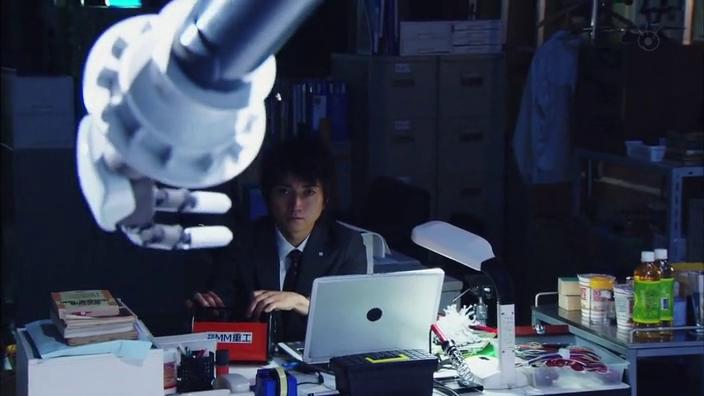
Software designer Suenuga Takuya (Fujiwara Tatsuya) will do anything to rise up the ranks of an industrial company and further his robotics design research with the latest prototype, Brutus. He's managed to gain recognition for his work and present himself as a viable match to the CEO's daughter (Ashina Sei). But when his intermittent trysts with a secretary (Uchiyama Rina) threaten to derail his ascent to the top, he resorts to drastic measures to ensure his bright future. Along with two colleagues who share the same dirty secret, they plot to commit the perfect crime only to find themselves as the target of an unknown enemy.

The first hour of the special beautifully sets up the dilemma of the characters and ratchets the tension with the planning and the commission of an ingenious crime. The second half, however, was not that strong as things slowed down to a snail's pace with the subsequent elimination of  would-be suspects. What many might find issue with is the forced manner in which two seemingly unrelated events are sewn together to explain the flow of events but to be fair, this is a common device used by the genre.

Side characters and tangential storylines can be expected to comprise a bigger piece of the puzzle and whether or not they fit in perfectly can be attributed to how well or how little is revealed. In this case, the denouement was an awkward affair due to the heightened attention bestowed upon the main character and the consequences of his actions.


Delivering yet again, a ruthless tenacity to a character that is broken and morally corrupt, Fujiwara Tatsuya managed to effectively convey the arrogance and desperation of a man driven to succeed at all costs. Since the special is told from the point of view of Suenuga, it was important to get an actor who can be intense and emphatic, vile and resolute; and for this purpose, Fujiwara's repertoire of roles is of great service. The only drawback to this approach was that the revelation of the identity of the killer was ultimately sidelined by the more pressing question of what would await such a man who had such a low regard for the life of others. 

As a mystery thriller, it had pacing issues and took on an overt moralistic tone. The portrayal of Suenuga's skewed sense of morality and purpose tend to dominate the story but further reflection would reveal the absolute brilliance of the drama's title in capturing its beginning, middle and end. The primary strength of Brutus no Shinzou can be found in its thematic consistency---it's a tale about a friend's betrayal and of one man's cold and traitorous heart; moreso, it's about the folly of committing one's self to another who is incapable of reciprocating the same love and devotion.    
Read More

Saturday, October 20, 2012

Anna-san no Omame


Breathing life into what could probably be the most annoying and dense character ever to be landed by a hafu celebrity, variety show-favorite Becky plays a rich, spoiled, delusional girl who wreaks havoc on the lives of men to head-splitting-throw-a-brick-at-your-television-screen-wanna-grab-her-by-the-neck perfection in a drama that can only be described as bonkers. Absolutely bonkers.

Mentally taxing for being ridiculously shallow, not to mention utterly pointless to the very end, Anna-san no Omame has a premise that would no doubt be funny or acceptable had it been a 20-minute anime feature but seeing it unfold onscreen with real live people is a whole different matter... Mitai na~

If there's any doubt that this series has the ability to firmly divide viewers on opposite ends of the love it or hate it spectrum, the fact that this came highly recommended by a trading buddy of mine (who also happened to tune me into Kekkon Dekinai Otoko) should be sufficient proof of its polarizing power. It's taken me four years to resume watching it after the shocking onslaught of silly that was episode one, and another year or so to decide to blog about it. And now in an effort to get it off my draft list, I present you with an antedated post that took another year to complete.
*     *     *


When a regular, nondescript man named Kyoutaro (Kashiwabara Shuji) gets to exclusively date the epitome of Japanese beauty in Anna (Anzu Sayuri), he's beside himself with joy. But dating the most-sought-after woman in town includes establishing ties and getting along with the person whom she considers to be an invaluable person---her friend and roommate, Lily (Becky). Under normal circumstances acceding to this request would not be such an imposition but as it turn's out Anna's friend has it in her head that she's irresistible to all men, including  Kyoutaro, when nothing could be further from the truth.

This misunderstanding of sorts would lead to countless awkward, and at times dangerous situations, which merely serve to cement Lily's belief that her exceptional charm and beauty is to blame for all the trouble that people close to her encounter. Of course, Kyoutaro would want nothing more than to distance himself from this loud, crazy-eyed girl who can't seem to utter a sentence without puffed cheeks and a twitchy gesture, but Anna is adamant to have him shadow her best friend in order to protect her from a host of unsavory characters. Forced to do her girlfriend's bidding, Kyoutaro manages to save Lily from sexual predators, ruthless hostesses and even gangsters; the unintended result, however, is that Lily is now convinced that he harbors deep feelings for her.

Over the top and repetitive with a humor that can be a tad offensive, Anna-san Omame offers a brand of comedy that is highly dependent on one shtick; it draws all its laughs on the supposition that a character as exasperating and naive as Lily exists, and that a person such as Kyoutaro would endure all sorts of mayhem just to be with a dream girl who's best friends with a lunatic.


This plot device is actually made more outrageous once the viewer gets to meet Lily's affluent family which apparently had a hand in perpetuating Lily's delusions. There's the overprotective brother (Ikeda Tsutomu) whose concern for Lily can be quite touching if one were not inclined to wonder where he gets the free time to stalk watch over his sister and the parents (Kusakari Masao and Takahashi Hitomi) who consistently lavish their child with praise, raising her to believe that the world is her oyster.

Utilizing whacky visual effects that can be surmised to have been inspired by the thought of what it might have been had the Care Bears and My Little Pony & Friends embarked on an acid trip, Anna-san Omame saturates the show with bright colors, fantasy sequences, and dizzying camera shots that spin and zoom in more than necessary. This is one of those series that is zippy and zany, making use of in-your-face physical comedy that might not sit well with viewers in search of intellectual stimulation. 

Subtlety is not its strongest point, in fact, everything about the production matches the potent energy of its protagonist. Lily's outfits are a cosplayer's dream and the set pieces that represent each of the three main characters reflect their different personalities, following a specific color scheme. Scenes are shot at unexpected angles, some as a testament to the giddy and unsteady tone of the series and even some turning out to be surprisingly creative and beautiful in their own right.


The series hits its stride when it decides to parody drama tropes and iconic movies. There's really not much to say about character development but some unexplained personality quirks and the occasional plot point tend to fool the viewer into thinking that there's more to it than previously expected. It's just unfortunate that the opportunity for exposition all turn out to be a joke and whatever glimmer of hope for an actual story is nothing but a hoax. For example, the reason for Anna's unwavering loyalty and penchant to brush off Lily's crazy antics is given a flimsy back story, while the opportunity to give Lily some depth and a possible happy ending is squashed when the series arbitrarily reverts back to its merry, non-committal tone. Whether or not one chooses to go for the ride is a matter of preference, but to its credit Anna-san no Omame does not aspire to be something that it's not, nor does it give the impression that it has a solution to this unusual love triangle.

Fledgling celebrity Rebecca Eri Ray Vaughan, popularly known as Becky, bulldozes her way through the series, showing unwavering commitment in playing Lily and all her insufferable inanities. This break out role seems to be the first of a series of obnoxious, grating characters given to Becky as a hafu artist, followed by her role as Tanya in the Nodame Cantabile series and her stint as the tempestuous Kaiko in the Kaibutsu-kun SP. Not counting her sweet and dainty singing career as Becky♪♯, this girl has unluckily been pigeonholed to flutter those lashes and use those green eyes to the annoyance of many, when she's obviously capable of so much more. She actually excels when allowed to do something else---of note is how she single-handedly carried the body-switch scenario in episode 6 and how she demonstrated her untapped potential as a romantic interest in the penultimate episode of this series. Her appearance as the outgoing Saki to Ito Atsushi's stiff and button-downed Kazuo in the fourth segment of Propose Kyoudai was a step in the right direction, however the noxious imprint left by this series will most likely linger on.
Read More

Wednesday, October 10, 2012

James Morrison : The Awakening Tour in Manila


Took some time off to catch the James Morrison concert last night.

Although admittedly not as familiar with his discography as my concert buddies, I did manage to listen to his latest album long enough to get the impression that it was a form of affirmation, if not a total celebration of sorts. Certain tracks sounded like a tribute, a veritable list of people and things that made this particular artist who he is today. The Awakening is arguably more upbeat than Morrison's previous offerings---I, for one, am amazed by the uncanny marriage of this singer's signature rasp and the Motown influence in his third album.

With a setlist of funky tunes intermingled with soulful ballads, this British singer-songwriter performed with a whole lot of swag, jumping and strutting on stage, infecting the crowd with his euphoric energy. The whole concert experience felt like a laid-back party with a take em' to church vibe and Morrison, the anointed preacher. With a unique gravelly voice (which I can only describe as one in dire need of a lozenge, but in a good way), this guy was a sight to behold as he unleashed his inner dance monkey before a crowd of onlookers who had no choice but to reciprocate his verve.

People probably came in droves wanting to hear sentimental hits like You Give Me Something and Broken Strings and let me just say that he didn't disappoint. He likewise sold his new material, singing up tempo songs like Beautiful Life and Slave to the Music whilst dialing things down a notch with heartfelt compositions like In My Dreams, I Won't Let You Go and  Say Something Now, all done with apparent ease and pride. 

There are performers who would often draw energy from the crowd but this one generated his own; he channeled it to everyone inside the Big Dome. This one had a light in him that made you stop wondering whether or not he took more than a swig of spiked Kool-aid, he had an energy and a force that can make you throw your hands in the air and say, "I'll have whatever he's having."

He was obviously having a good time that night and so were we. 

 *    *   *
Concert picture courtesy of Inquirer Entertainment
I initially planned to use a different picture for this blog post, but the picture that came with the Inquirer article pretty much captured the feeling of seeing Morrison work his groove.
Read More

Wednesday, September 19, 2012

San Lazaro


Odd and yet surprisingly insightful, with just the right amount of tongue-in-cheek commentary about life, love and Youtube as a learning tool, Wincy Aquino Ong's San Lazaro peddles itself as another Asian horror movie that makes you assume that its focal point is a supernatural entity when in fact, it's all about inner demons---the kind that reside within, the kind that's powerful enough to disregard one's conscience, the type that can gnaw at one's being.

Going by the trailer, it's quite easy to tell that San Lazaro is not the type of  film that is capable of generating the same buzz as Cinemalaya entries like Ang Babae sa Septic Tank or Rakenrol. Neither does it have the mainstream draw of the adaptation of the Eros Attalia novel, Ligo na U, Lapit na Me. And while the premise of having two old schoolmates embark on a road trip to a far flung provincial town with the primary objective of taking a demonically possessed sibling to be treated by an exorcist may trudge on B-movie territory, the film manages to achieve a well-orchestrated dissonance, one that defies genres and intentionally throws off viewers but not without some satisfying revelations.

It can be likened to your uncle's trusty Volkswagen Beetle that's old, personally put together and full of character. Old, not because there's anything unoriginal about the script or the story, but rather old in the sense that it's the best vehicle available given budgetary constraints and its novelty. It's a bumpy and unpredictable ride but what's important is that it gets you to your destination.        


Aptly described as a horror flick, a road movie and a buddy comedy, San Lazaro gives its viewers a weird, disjointed journey into the lives of three individuals haunted by personal ghosts. There's awkward Sigfried (Wincy Aquino Ong) who's never had a girlfriend since birth, brassy Limuel (Ramon Bautista) whose bravado comes with a cache of tranquilizers [strong enough to put down an elephant] and troubled Biboy (Nicco Manalo) who may or may not be under the control of a malevolent spirit. 

Armed with a quirky selection of storylines which include a white collar crime and a woebegone search for Captain Barbell, told alongside the ill-advised transport of an unstable passenger who's spent too much time talking to an antique garden ornament, this is one film that revels in its geekiness and yet manages to tap into certain uncomfortable truths that are funny but not entirely laughable. The horror aspect of it has a distinct Filipino flavor; the random topics that make up the conversations between the characters can come across as either glib or smart but not to the extent of grating, verbal diarrhea, as can be seen in other productions. There's also a general sense of unease that accompanies the staggered flashbacks given the characters' seemingly close-eyed determination to suppress unwanted memories. The deadpan delivery of both Ong and Bautista effectively blurs the comedic and dramatic, while Manalo's commitment to the role serves as a reminder that there are greater forces at play that should not be ignored. 

All said, San Lazaro is not your typical horror flick; it's predominantly a dark comedy with some jarring and amusing turn of events. With special appearances by Bianca King, Julia Clarete, Ely Buendia and Kean Cipriano, and spot on performances from the likes of Allan Forte, Tony Gallano and Earl Ignacio, it's a film with a number of interesting sequences, some even shot with an obvious nudge and wink to make you in on the joke. Hammy, creepy and sobering at one go, from the minute the award-winning opening sequence by Burnwater Design Studios rolls alongside original music by Mikey Amistoso and Jazz Nicolas, you know that you're in for an adventure.
Read More

Thursday, August 09, 2012

Snow Patrol: Fallen Empires Tour in Manila


Light up, light up.... I'll be right beside you dear.

After having half the city submerged in flood water barely two days ago and experiencing torrential rains for almost a week, the sun finally came out today like a beacon calling to all Snow Patrol fans to come out and rejoice, for the concert would push through as scheduled.

Rain or shine, I already made up my mind to go. I initially planned to attend the block screening of The Bourne Legacy at the Mall of Asia but ended up missing it because of the bad weather so the only highlight of the week was this concert, which---in all honesty was something that I've been looking forward to for two...three months now. Luckily, the rain let up long enough to make the roads passable to light vehicles, so off I went to the concert venue to witness an awesome show and more importantly, listen to some good music.

Okay, so maybe some people consider Snow Patrol quite mawkish and maybe not everyone has heard of the band and their music (even though they've had at least one or two songs featured in Grey's Anatomy and just about any CW series), but at least, in my mind, they're not as big and cloying as Coldplay, nor as heavily criticized or ridiculed. Underrated and inconspicuous, that's what they are, but you would not have thought of that seeing the number of people who turned out at their concert earlier tonight.

There was a shared feeling of excitement as the crowd listened to the remix of Berlin and watched seven LCD panels deliver colorful visuals timed to the music. By the time the band hit the stage with tracks like Hands Open, Take Back the City and Crack the Shutters, the crowd was on its feet. People were cheering, clapping, singing in unison and the sheer energy brought by the audience was equally matched by frontman Gary Lightbody, who conducted the event like a seasoned performer. He kept the people engaged, made small talk and even introduced songs between sets as expected of a singer/songwriter in an old school band.


The band sounded great, the lighting design was top notch and the images projected onscreen complemented the music. I had no doubt that people went home happy to hear a great selection of songs from the band's discography.

Crowd favorites such as Chasing Cars, Run, Chocolate and You're All I Have were performed with just about the same reverence and fondness as recent material from their latest album. I had a kick listening to the melancholy vibe of New York and Make This Go on Forever, the irreverent beat of Fallen Empires, and the fading grandiosity of This isn't Everything You Are. There's something to be said about the simplicity that one can find in Snow Patrol's music---the steady repetition of words and phrases in their lyrics, and the almost timeless appeal of hooks and bridges in every song melody that triggers an emotion or memory, that makes a person sing one's heart out. Lightbody's voice has a raw yet sincere quality to it; there's a quiet desperation in it that people can easily relate to without necessarily being burdened or oppressed by its weight because the songs that he sings are never without hope. Sentimental, yes, even to a fault. But there's hope and promise behind every tune and there's hardly any bitterness no matter how sad its origin. Of course, it also helps to mix things up a little by experimenting with different beats and dabbling into techno/electronica music.

As an encore, the band played Lifening which was a wistful, sentimental song that speaks of happiness that can be found in the simplest of things. To cap off the night, Just Say Yes was performed amidst blue-white flashing lights and the distinct, Irish way in which Lightbody sang the line, "Please take my heart..." to an already smitten crowd. It was a superb concert, the best one I've seen so far this year.         

--------------------- 
 As usual, I can't be expected to take any pictures.
 Concert photo by Imaginary Ordinary 
Read More

Thursday, May 03, 2012

Surely Someday


It is often said that "imitation is the sincerest form of flattery." If that be true, then Guy Ritchie should be floored by the level of appreciation that Shun Oguri has shown for his use of slow motion effects and time lapse photography. Yes, the actor best known for playing Hanazawa Rui (Hana Yori Dango) and Suzuran faction leader, Takaya Genji (Crows Zero) has gone to the extent of crafting an outrageous, coming-of-age film that pays homage to [if not totally replicating] the cinematic style of Lock, Stock and Two Smoking Barrels, minus the narrative punch provided by a clever screenplay and the kickass factor contributed by Vinnie Jones or Jason Stratham.

I remember my sister telling me about this movie project in the same breath as sharing the latest rumors about Oguri being a horny dog, but I never really placed much thought into it since: (a) she couldn't tell me the title of the movie at that time; (b) Shun Oguri always struck me as the kind of actor who worked best in an ensemble, which, to me, meant that if he didn't have the draw or star power to carry the lead role, then chances are, he wouldn't have the ability to helm a full-length movie feature; and (c) I couldn't care less about which girl/jpop group member he banged at allegedly took to a motel.

About this time last year, I was doing some prep work for that Arashi post that I've always been meaning to do but never got around to doing, and even though the said post never materialized, I ended up watching a number of Japanese variety shows hosted by Japan's "national idols". One of the shows I managed to catch (thanks to fans who shared the said episode on a streaming site without the permission of the subber) happened to be Oguri's promotional guest stint at Arashi ni Shiyagare where I finally learned the movie title which was シュアリー・サムデイ or going by the boys' phonological speech, "Shuari Samudei".

*     *    *


In this dramedy of errors, penned by writer Shogo Muto, five high school friends barricade themselves in a classroom with a home-made bomb in protest of the cancellation of their school festival and the corresponding "annihilation" of their dream to perform as a band. Brimming with hope and the promise of being surrounded by adoring fans through their music, Takumi (Koide Keisuke), Kyohei (Katsuji Ryo), Hideto (Ayano Gou), Kazuo (Suzuki Ryohei) and Yuki (Muro Tsuyoshi) mount a successful campaign for the reinstatement of the festival but when they fail to defuse the prop time-bomb  they had set up to facilitate negotiations with the school administrators, the damage caused by the explosion would later prove to be monumental not only to the lives of these boys.

Surely Someday provides a spry yet unbalanced story about how chance encounters and circumstances can produce a ripple effect that would link two seemingly unrelated events that in the long run would produce irreversible consequences. There's a network of people involved in this slapdash tale, such that the connection drawn between these wayward teens and a former prostitute (Konishi Manami) would span a number of years, beginning with a summer childhood adventure to Kabukicho and a botched up sting operation. The film hurtles back and forth between the past and the present as all five find themselves tainted, unable to move on from the incident.

Now a feckless bartender, a third-rate college virgin, a fledgling yakuza, a street busker and a hikikimori find themselves in trouble once again as their past catches up with them. They have no choice but to make amends, find each other and reunite long enough to take care of unfinished business; what's more, they need to retrieve 300 million Yen before yakuza boss Kito (Yoshida Kotaro) sends his men to ice them.


Fun and upbeat, Surely Someday is a film that can not be taken seriously no matter how hard it tries to infuse its storyline with some edgy scenes and grim but oft times, shallow existentialist musings about lost youth and opportunities. It's full of high school hijinks and flailing commentary about people who put their life on hold, set to punk-rock music, peppered with drugs, money laundering, even some violence and undignified [non-metaphorical] boot licking. Decidedly the result of a well-meaning and excitable collaboration, the movie tends to be overbearingly gratuitous in its execution and unbelievably self-conscious in acquiring a modicum of street credibility amidst the fanfare. This is no Go or American Graffiti but a rollicking, hyper-comedic Japanese production containing familiar elements of what made a movie "cool" in the late 90s.

For a directorial debut, Surely Someday is quite a mediocre offering---it comes chock-full of novice mistakes, betraying the lack of vision or originality on the part of Oguri to work behind the camera and instruct his fellow actors towards achieving a good take. He seems to have approached the film as he would a goukon by calling in favors from friends and co-workers (judging by the number of cameos), giving them free rein to act and [over]react as they see fit without any instruction. There are indeed times when the scenes felt like an impromptu comedy sketch, given the hammy delivery of lines and the cast's acting choices.

There's also the sudden shift in tone with very little lead in, thus catching the viewer by surprise as the droll buffoonery of its first act gives way to an adorable yet short-lived segment featuring the characters' childhood, interrupted yet once again by some clumsy action, more melodrama and a failed Sugar & Spice routine set in the present. Oguri's artistic choices do not often work; the overdone 10-second recapitulation of each character's three-year activities, the white footprint suit donned by the yakuza boss,  or even  the slow motion off-target gangster shoot out set to the tune of Schubert's Ave Maria (which brings to mind the game Hitman), tend to be whimsical additions rather than valuable set pieces.

Despite its flaws, Surely Someday is, by all accounts, not a bad movie. There's enough story in it to keep a viewer entertained provided one can overlook the uneven acting. It would have been much better had there been competent and assured direction from Shun Oguri, however as it stands today, it's quite clear that his ambition appears to have exceeded his ability.
--------------------- 
 Photo credits/Movie Stills by Asiabeam and Ramen
Read More