Sunday, November 28, 2010

Reinventing Sherlock


When I find myself in need of a break from watching Asian dramas or simply in search of respite from reading subtitles, I usually look on to the BBC to provide me with alternative entertainment. Most shows take anywhere from 3 to 13 episodes, so like your standard jdorama, it only takes a relatively short time to go through a season. Since I've had a good run with Merlin for three years now, I figured it wouldn't hurt to check out what they can do with another reboot of  a classic character, this time in the form of Sherlock Holmes. I wasn't expecting much from it really, but after watching the first episode, I found myself hooked and loving it. So if you haven't seen it yet, I suggest you go watch it immediately. A definite must-see this year.

*   *   *
When BBC/PBS announced their intention to create a Sherlock Holmes series set in modern-day London earlier this year, a lot of people couldn't help but question the propriety of updating such a well-loved and iconic character for television. Coming on the heels of the Guy Ritchie adaptation, the public wasn't so sure whether they were ready to see the great detective once again, and in such a short period of time, without his signature fore-and-aft deerstalker cap, inverness cape and curved calabash pipe, solving cases outside of the Victorian period. It didn't seem like such a good idea to rework such a classic figure, especially when actors such as Basil Rathbone and Jeremy Brett have already left an indelible mark in playing the said character. To do so, was to court disaster; but to do so and get away with it, would simply have to be a work of genius. And that's basically what creators Steven Moffat and Mark Gatiss's Sherlock is---inspired work.


Away from the fog and the gas lit streets of the Victorian era, the Beeb's latest incarnation of Sherlock Holmes is young, dapper and tech-savvy; possessing all the eccentricities and resourcefulness of the Arthur Conan Doyle original, albeit now more pronounced, having been adapted to a contemporary setting.  Meanwhile, Dr. John Watson, who's previously been relegated as the bumbling sidekick in a great many screen adaptations, now gets the respect he deserves, being portrayed as a solid and capable fellow.

The pilot episode, A Study in Pink, recounts how the two first meet and end up solving crimes together, all in the course of taking up residence at 221-B Baker Street. It's an absolutely brilliant episode, penned by series creator Steven Moffat, that's set up to provide sufficient character exposition. It alone gives tremendous insight as to what qualities and attributes that make up for Sherlock and John's odd yet interesting partnership, all the while engaging audiences with this mystery that involves a slew of suicides, the cause of which, the police have trouble figuring out on their own. What makes this episode particularly memorable is that not only does it sparkle with wit and humor, it's also smartly written and paced in a manner that pays homage to Arthur Conan Doyle's works without necessarily censuring itself from introducing enough changes to keep the material fresh and original. With excellent cinematography and wonderful camera work that can rival that of a full-length movie feature, the first episode of this series directed by Paul McGuigan is a certified winner, not to mention a rare piece of television. 


I'm a high-functioning sociopath, do your research.

Benedict Cumberbatch is excellent as the 21st century Holmes; he is a delight to watch, as is Martin Freeman, who winsomely plays the great detective's esteemed colleague. They play off each other so well  that it's not hard to imagine why this legendary pairing between an invalided army doctor and a consulting detective in literature is so well-loved.

Cumberbatch's version of Sherlock is by the book, highly intelligent and scientifically inquisitive, peerless and impressive, appallingly obnoxious and more so, painfully exacting in his social ineptitude. In order to demonstrate the character's superior mental acuity for observation and deduction, Cumberbatch delivers some of his lines in a flurry, at times they're even spit out in an exasperated tone---clearly to lay emphasis on the fact that words often fail to coincide with  the speed in which Holmes has assembled  the facts and therefore, everyone else has to pick up their pace to keep score. It's a spot on performance, one that calls attention to both the character's brilliance and underlying compulsion to prove himself  superior. He also does quite well in showing Holmes's occasional fits of lethargy, particularly when the detective finds himself without a case to solve in order to make life a little less boring.

Equally noteworthy in the role of Dr. John Watson is Martin Freeman, whose earnest demeanor and appeal provide a wonderful yet endearing contrast to Cumberbatch's domineering presence as the great Sherlock Holmes. Playing the loyal friend and chronicler, he's the guy who best represents the viewer;  one who's synchronously impressed and baffled by Sherlock's intellect and its "limitations". Proving himself indispensable as the everyman in the course of each adventure, Freeman's Watson is perhaps the one closest to the original---he's strong, reliable and practical, he's the heart and conscience to Sherlock's detached objectivity, the sole anchor that gives the genius a semblance of humanity. 


Of course, the two are drawn together out of a need for action and adventure, and The Blind Banker, finds the two of them officially turning into a crime-fighting duo and settling down into their respective roles. The second installment to the said series comes off more as a routine episode, as Sherlock and John find themselves at odds with a Chinese smuggling syndicate, after being asked to investigate a mysterious break-in at an investment firm. Writer Stephen Thompson works with a locked-room mystery and delineates the case with a certain level of detail and difficulty, making it an episode worthy of the attention of Sherlock Holmes.

The third episode, The Great Game, packs a mean wallop as writer-creator Mark Gatiss fills up the show's 90-minutes with bite-size mysteries to set up the first appearance of Sherlock's archnemesis, Moriarty. It's an ambitious episode that plays on a heightened sense of danger; it's fast-paced and dense with information, leaving audiences hanging on to every word and breathless with the onset of action. It  also beautifully tracks the development of the relationship between its two main characters, with particular emphasis on Sherlock's tendency to obsess over certain matters. The whole endeavor ends on a nail-biting cliffhanger that's certain to keep audiences eager and hungry for its next season. In sum, the BBC series, Sherlock, is a remarkable piece of television programming. It's probably one of the best, if not the best to come out from across the pond this year. Those looking for quality entertainment should definitely consider putting this on their watchlist---not only is it worth every minute of your time, but you'd be hard pressed to find another pairing with such charm and chemistry.    
Read More

Sunday, November 07, 2010

Osamu Tezuka's MW

I don't normally read manga because I don't have the time and patience to leaf through volumes of an ongoing series generally designed to entertain people half my age, but I decided to give this one a shot seeing that  there's an official one-volume release in english by VERTICAL and because not being the type to leave well enough alone, I had a few issues to sort out after seeing its big screen adaptation. It's the first of three mangas by Osamu Tezuka that I managed to finish, and while I found the overall experience to be fairly entertaining, what really captured my fancy was the author's layered attempt at making a socio-political statement in  the midst of creating something superciliously controversial and "shocking" to meet public demand for more serious and dark, adult-oriented material... in other words, something different from what they would normally expect from him.

*     *     *

Osamu Tezuka's well-known for his contribution to the world of manga with enduring classics like Astroboy, Phoenix and Black Jack forming an integral part of his legacy, but as any certified manga buff would  attest to, his body of work was by no means limited to producing wholesome, kiddie fare, as the man dubbed as the kamisama of manga was apparently competitive enough to submit a few entries in response to the gekiga movement that gained popularity in the 70s.

MW is the story of a psychopathic killer, a priest and the former's obsession with finding a chemical warfare agent, which happens to be the subject of an intergovernmental conspiracy. From page one, the reader is brought in the thick of the action, where a frantic father is seen delivering ransom money to a designated pick-up point, only to discover his beloved son dead, ruthlessly murdered by the kidnapper. The criminal successfully evades the authorities through the aid of a priest, who is apparently conflicted and wracked with guilt but is somehow unable to bring this evil man to justice. What follows then is an account of how the two meet-- of how banker Yuki Michio and Father Garai Iwao shared a history, a secret which they hide away from society-- being the only survivors to a deadly gas leak which killed the inhabitants of an island, ultimately, dictated the way they lived and  inevitably bound them together to suffer a dysfunctional yet enduring relationship. And so begins this convoluted tale of madness, forbidden love and violence, as two boys who once held each other in a dark cave find themselves at odds with each other a decade or so later, but still unable to completely withdraw from each other.

Considered by most to be Tezuka's darkest work, MW provides an interesting examination on the nature of evil, the value of sacrifice, the commission of sin and man's continuous search for redemption in a world that can't be expected to pay attention to one thing, let alone have faith in something. Serialized in 1976-78, the manga contains undeniable references to particular places and events; characters are drawn in a certain fashion, firmly grounding the story's setting to a specific period, in effect providing a good measure of social commentary and political intrigue, almost enough to justify its more gratuitous and salacious content.

From the heart-stopping suspense, unabashed melodramatic elements that at times can come off as rather cheesy, to the more sensational and latent points of controversy, Tezuka's MW unabashedly tackles sex,  murder, homosexuality, political activism and terrorism with relative aplomb and mediocrity. There's a certain liberality as to how the story's villain is portrayed;  Yuki, being an amoral being, is shown to kidnap, extort, rape and murder at will in order to bring his diabolical plan to fruition. No person is spared  and nothing  is sacred, as Tezuka repeatedly displays the said character's penchant for cruelty; allowing him to perform heinous crimes with glee. MW paints a dark and sinister world where children are collateral damage, women are sexually abused and discarded, and mass murder can be committed without any thought or consequence, to the extent that the perpetrator goes scot-free. It's a place where the few who seek the truth are rewarded with their own brutal and untimely death; where faith and religion shine a dim light, and man's base desires weaken one's resolve and dominate over one's conscience.

Needless to say, Tezuka succeeds in making something close to a gekiga by packing MW with contentious material to meet a certain criteria; there are sections in it that were obviously designed more to alarm and shock readers than to nudge the story forward but that much was expected of the medium at that time. As a result, the manga panders and detours to include insignificant plot devices and side stories, giving it the illusion of greater depth and complexity, when all it needed was a more convincing ending, a better wrap up to the grandiose storyline that it  managed to establish. The great thing about it though is that while it's severely hampered by the trappings of its genre, there's nothing in it that's offensively explicit or graphic that will turn off a first-time reader. It might not have the epic scale and holistic finish  of Ode to Kirihito nor does it have the same trippy visuals and psycho-sexual pondering of Apollo's Song; but what sets it apart from his other works is that it's rather evocative of its time and unmistakably forthright of its stand on certain issues as competently discussed by Kristy Valenti in her piece entitled In Defense of Tezuka's MW. Like it or not, the man behind this controversial manga was a prolific storyteller. His artwork might be garishly cartoonish by today's standards, but a good number of his works do remain relevant and readable. From telling the tale of a robot boy who's more human than his inventors, to recounting the adventures of a samurai intent to retrieve his body parts from 48 demons, there's going to be at least one or two of his works that will speak even to the most hardened reader because he never failed to infuse his works with some food for thought.
Read More

Friday, November 05, 2010

Off a Bridge, Into the Mist


"It must be exciting to be a fighter, to be totally free." 

Stuck in a hotel room out of town, without a laptop and any internet access, I ended  up watching a  documentary on cable entitled The Art of Action: Martial Arts in Motion Picture. Filmed in 2002, the said documentary provided a general overview of the martial arts genre-- tracing its origins and influence  back to the Peking Opera, citing iconic figures and films of note, showcasing clips of classic and modern movies, along with various interviews of directors and artists.

At that time, the genre was at the height of its popularity, it figured prominently in Hollywood movies, and slowly found itself a new audience, one used to the high-octane action and the colorful frenzy offered by MTV. Jacky Chan was on his way into becoming a household name in the West, wire-fu was in vogue and of course,  Crouching Tiger, Hidden Dragon, being one of the most celebrated films from the East, became a frequently discussed topic.

Impressing both critics and audiences worldwide, Crouching Tiger, Hidden Dragon, represented the best of Chinese cinema, and therefore it was no surprise that the documentary singled out this movie for its breathtaking images, gravity-defying fight sequences and most of all, its tragic love story. The movie in itself might not have had the same success and recognition it enjoyed in the United States as in its native country, but Ang Lee's first entry into the wuxia genre certainly made quite an impression on the industry and the  general viewing public. Everyone had their own take on the film and basically everyone had their own personal reason for loving [or hating] it. And while Chinese audiences initially shunned the overly romanticized elements of it and treated the martial arts sequences as standard fare for such films, the fact that it took home an Oscar and became an acclaimed box office hit abroad made a lot of people sit up and take notice.

Director Tsui Hark attributed the film's success to its story and how the issues confronting its characters, specifically that of a rebellious teen, remain relevant in contemporary society; Donnie Yen, on the other hand, effusively praised the poetry of specific scenes; critics and film analysts adjudged it to be a prime example of how arthouse cinema successfully crossed over to mainstream; and just about any martial artist/actor/stunt man harped on Yuen Woo-Ping's unparalleled skill in choreographing fight scenes that matched a  film's aesthetic.

"Whatever path you decide to take in this life... be true to yourself."  

There's certainly much to appreciate about this movie, for Crouching Tiger, Hidden Dragon appealed to everyone's sensibilities, providing a potent mix of action, romance, political intrigue, and social commentary in one beautiful period piece. To some, it's a love story of epic proportions, to others it's a carefully crafted tale about three women's struggle for identity and honor in a male-dominated society steep with stifling conventions and outmoded traditions. Within a decade of its release, numerous interpretations have been made regarding the movie's underlying theme(s), fans and netizens have come up with their own theories, but very few really focused on tying everything up with the movie's ending.

Artistically rendered with care to the very last frame, Crouching Tiger, Hidden Dragon admittedly gives way to a bittersweet ending-- Jen (Zhang Ziyi) tells Lo (Chang Chen) to recall the legend that he told her in the desert about how a faithful heart makes wishes come true. She then asks him to make a wish before slowly falling off the bridge of Wudan, descending into the mist; in calm surrender, in atonement for her sins. It  seemed like a fitting end to a tempestuous maiden who deprived two people of a chance at happiness but speculation soon surfaced as to whether or not the legend in the film held special meaning... was it merely a device inherent to the genre or was there actually a message behind it?

So Jen gracefully disappears into the mist on account of a legend, with the intention to right past misdeeds, leaving the audience wondering about the reason behind her actions and Shu Lien's reminder, "to thine own self be true".

Watching the documentary made me think about this part of the film, particularly when Ang Lee only gave a statement about how it was a dream of his to film a female character drift serenely into the clouds, without so much as a word on what he meant by giving Crouching Tiger, Hidden Dragon such an ending. I've read quite a few reviews over the past years and have encountered countless musings on the movie's source material, its connection to Eastern philosophy and how characters' names corresponded to the title of the movie, but none of them captured my imagination as Matthew Levine's thought-provoking article in Bright Lights Film Journal-- Crouching Tiger, Hidden Dragon: The Art Film Hidden Inside the Chop-Socky Flick -- which argued for the presence of strong feminist themes with the fearless postulate that Jen, in all humility, did not only seek redemption by throwing herself over that bridge; she also wished with all heart to be reborn, to be free. When I first read this article, I couldn't believe how much this single line of thought changed the way I viewed this movie. It shifted my attention away from Li Mubai and Shu Lien's love story and permanently drew  my thoughts toward Jen and her dilemma; and there it stayed indefinitely. Five years later, I'd still catch myself thinking about Levine's thesis, others might have reservations about it, but every time I see a Crouching Tiger, Hidden Dragon clip, I can't help but feel sad for Jen and a part of me would always wonder whether she got her wish.


---------------------
Special thanks goes to patrick at http://psdragonfly.livejournal.com/18661.html for the beautiful screencaps that accompany this entry.  
Read More

Wednesday, November 03, 2010

Bloody Backlog


Oh my poor neglected blog. Who would've thought that blogging would require so much work? It's rather hard to keep up when the world is so full of distractions... Guess it's high time I get my act together and finish all those pending reviews. Been working on bits and pieces without managing to focus  long enough on just one to bring it to completion. And  of course, September rolled in and I had to follow my weekly dose of Dexter and Merlin, which screwed up my one blog entry a week tenet (yeah right, wishful thinking) and by  the time October came, I had to finish my long overdue assignment of typesetting episodes of Sukeban Deka for SkewedStudios Fansubs and Scanlations (sigh*). So to make a long story short, I suck at multi-tasking, hence the sorry state of this blog.

Given that I haven't published anything in over a month, I decided to make an extra effort to get this thing updated. The gameplan was to take care of all my backlogged entries this November (or at least try to cut them down to half)  and abstain from starting on another series till I'm done working on my current line-up. Sounds simple enough, right?

Well, I could not have been more wrong. True to form, I already violated the said rule when I spent the past weekend sloughing through the mess that  my sister laughingly referred to as Buraddi Mandei. And here I thought Security Police had the over-the-top-anti-terrorist-scenario-trophy in the bag but it appears that Falcon and a bumbling counter-terrorist division known as Third-i, along with a bunch of misguided kids would have to take home the award. Which reminds me, our copy of Bloody Monday 1 & 2 is now up for adoption.

This drama has a virtual menagerie of birds and insects, sloppy assassins who can't even be bothered to use a silencer (let alone be expected to tie their rebonded hair), an incompetent government agency with an acronym that fails to command respect (PSST!), and children of a cult leader who like to go by a certain letter in the alphabet. Furthermore, pretty boys and seductive girls are abound, plus the clickity-clack of the computer keyboard's there to signify that the earth....errrr world... is safe and sound.

What more can you ask for? It's just twenty or so hours of non-stop plot twists that defy logic and explanation, apparently, the whole thing is too complex and only a mathematical genius can map out the equation... NOT! But who cares about such trivial things when people are searching for a cure to a virus and  life as we know it is threatened by a nuclear explosion? Right? RIGHT? Anyway, if there's anyone out there who would like to give this drama a shot, I'd be more than happy to leave the darned thing inside a toilet tank under lock and key. Details as to the stall number and the location of the public toilet where the said package can be picked up will be texted to you as soon as you pour your heart out online and pledge to join my army to restructure Japan and whatnot. Go save the earth, why dontcha? Reduce, reuse and recycle.
Read More

Friday, September 17, 2010

Snakes and Earrings


A young woman's quest for a forked tongue leads to a dangerous love triangle where pain is associated with pleasure, sex is meted out with violence and the desire to possess another culminates in murder. Director Ninagawa Yukio's film version of Kanehara Hitomi's Hebi ni Piasu is a faithful adaptation of the book which won its young author the Akutagawa Prize for literature in 2003, but there's just not enough  material in a  novella about the existential plight of an overindulgent teen  to make for a compelling movie.

Saw this movie approximately a month ago and picked up the book not long after that-- not that I was particularly interested in the book, I distinctly remember passing it up a year or two ago, but then I decided to read it anyway  in hopes of gaining more insight on the story and doing a better review. Turns out reading the book was wholly unnecessary because what you see in the movie is pretty much all there is. The book is grossly overrated, in the same way that I think Wei Hui's Shanghai Baby is undeserving of its international success. If you're the type who's new to this kind of literature then I guess Snakes and Earrings can also shock and impress, but my vote still goes to Kirino Natsuo. 

 *   *   *

Nineteen year-old Lui (Yoshitaka Yuriko) is beautiful, bored and listless. Wandering around the streets of Tokyo at night, she gets invited by a foreigner to step into a club where she meets a heavily pierced and tattooed punk named Ama (Kora Kengo), who shows her his forked tongue. Finding herself inexplicably fascinated with the idea of having a serpentine tongue, Lui spends the night with Ama and immediately moves in with him after resolving to have her own tongue split to match his. Ama introduces Lui to Shiba (ARATA), a tattoo artist and a piercing professional, to get her started on the process by having her tongue pierced.


Not satisfied with just getting a 14g stud clamped in her tongue, Lui decides to push herself further by getting a dragon and a kirin tattooed on her back. She commissions Shiba to design it for her and pays for his services through sexual favors. She carries on an affair with Shiba whilst continuing to come home to Ama, all the while being bored and unhappy with the "normal" life she's been leading. Caught in a whirlwind of angst and despair, Lui  finds herself unable to choose between a man who claims to love her enough to kill for her and one who claims to be so enamored as to be tempted to put an end to her, that is, until one act of violence  becomes the deciding factor in the said stalemate...

Set in contemporary Japan, Snakes and Earrings offers a bleak and trite view of the world as seen through the eyes of a wayward teen, as she immerses herself in what she perceives to be a dark and intriguing subculture. It's a movie that touches on a number topics such as body modification, sado-masochism, possession and nihilism but fails to fully explore any one of these themes, particularly because the main character's sense of aimlessness prevails over everything in it. There's a certain affectation to its narration, the pacing is slow and the turn of events inconsequential; this is one film that banks on showcasing an alternative lifestyle, both for its novelty and its ability to shock those who abide by the norm, the drawback to this is that because there's little or no explanation of its characters' motivations, its alleged honest and brutal depiction of today's times comes off more as an artifice than an actual reflection of the problems that beset today's youth.

"I want to be part of an underground world where the sun doesn't shine, there are no love songs, and the sound of children's laughter is never, ever heard."

Self-absorbed and fickle, its protagonist, Lui, endeavors to become a part of Tokyo's seedy underbelly for unexplained reasons. Her slow and steady path towards self-destruction leads her to expose herself to excruciating pain and/or danger by enjoying the thrill of having casual sex with multiple partners. She's a 21st century wildchild who belongs to a new breed of rebels without a cause, one who's desperately trying to feel alive, one who's fighting the languor taking hold of her system. Reading about her exploits in a 118-paged novella is one thing, but seeing her vacuous life unfold onscreen is a whole other finicky ordeal.

The main problem with this movie is that it has a female lead that is running on empty-- she fails to garner sympathy or elicit understanding, mainly because she herself admits that she's depressed and disgruntled over nothing. There's nothing to be fixed, no solution to be found, because there's no problem to begin with. All her choices are made out of caprice; her adventures, all meaningless and pointless exercises designed to distract her from her self-imposed misery. In this regard, Snakes and Earrings is no different from any post-modern literature or cinematic feature about troubled teens or anguished adults who seem to have lost their footing. It captures the alienation and early disaffection of a new generation, offering a cocktail of sex, tattoos and alcohol in lieu of the prototypical combination of sex, drugs and rock-and-roll. What makes it such a forgettable venture is that it does absolutely nothing in providing any insight as to the cause or design behind this ennui, neither does it break new ground in terms of its genre, given the sheer volume of films available on how hard it is to be a kid growing up in today's society.


Told in roman à clef by a beautiful and nubile author whose face appears in full color as an endsheet to the book, it's no surprise that this fantastical account of a person's immersion into an oft misunderstood and grossly misrepresented segment of society gained so much acclaim and attention despite its meager content. It's because people will always be drawn to the unknown, the bizarre, and Kanehara Hitomi's Snakes and Earrings offers a hefty dose of a world wherein a  person can claim to love a man without bothering to know his name, where teeth yanked out of someone's mouth is offered as a love token, and where the urge to kill is strongest during the act of intercourse. It's a fascinating and disturbing world for those who wish to witness it vicariously, unfortunately, while some choice words may prove to be adequate to describe a certain event or emotion on the written page, the same cannot be said of the material once it is brought to the big screen.

From its near silent opening where Tokyo is seen through Lui's vacant eyes to the angst-filled monologue devoid of any emotional impact, this movie makes the viewer feel more like a detached observer than a would-be confidante. The screenplay is bogged down by the hapless musings of a young woman who's offensively naked of any depth or substance-- on paper it reads like an adolescent's fatalistic tirade, one that discusses the acute feeling of helplessness that envelops her to the point of  wanting to die so as to be rid of all this suffering; on screen, what the viewer sees is an inordinate amount of moping, interrupted only by harried sex with mild bondage, followed by an incomprehensible resort to binge-drinking. Verily, what might capture the imagination or tickle one's fancy while reading the book might not have the same effect  visually because a line or two of text on an abstract concept does not necessarily translate well onscreen especially when the message or thought behind it is ambiguous and illusory.


Underwhelming as a whole and at times agonizingly insular as told from a lost child's limited perspective, director  Ninagawa Yukio's latest cinematic feature doesn't have the same emotional draw as his previous works-- it doesn't have the palpable tragedy of Waru Iemon nor the quiet complexity and  absorbing characterization of Ao no Honō. Chances are, it would probably be best remembered as the movie where Yoshitaka Yuriko artistically bared it all and yet somehow still managed to look dull and unappealing. The young actress just doesn't appear to have the range or perhaps the experience from which to make something out of this poorly written role. She puts on what most would consider a brave performance but she doesn't go beyond portraying Lui as this plastique, soulless doll. More often than not, she sounds and looks like a  spoiled and whiny brat instead of a tormented, world-weary individual. Furthermore, she's rather flat and unconvincing when it comes to the more erotic elements of the story, but then again, it's no easy feat to visually interpret the masochistic tendencies of a person who gets aroused by a needle stuck through her tongue as the book would have you believe:

"The next moment there was a clamping sound and shivers much greater than those of an orgasm shot through my entire body. Goosebumps ran up my arms and my body went into a slight spasm. My stomach tightened and for some reason so did my crotch, where I felt an ecstatic, tingling sensation."

Again, it's easier to make use of words to describe a particular sensation but bringing something like that from page to screen requires an actress to convey so much more than just drawing tears in her eyes with an expression that  looks like a half-wince-half-grin, the same goes for most of the sexual encounters in this movie. ARATA does slightly better, playing Shiba with a calm facade to mask the cruel temperament of his character. Soft-spoken and yet still menacing with delusions of being a god in his own right, he does well in balancing the severity of having a face full of piercings and a body like a canvas with his seemingly aloof and professional stance as a tattoo artist. Kora Kengo on the other hand plays Ama to dopey perfection. He's a misfit by way of looks and yet conventional in his everyday living; he's sweet and excitable, prone to violence and yet still naive when it comes to weighing the consequences of his actions. Watching the movie, it's quite clear that all three actors performed to the best of their abilities, the only catch is that none of them was ever able to rise above the shortcomings of the material that they were working with. As such, all three characters remain strangers up till the end of the movie, ultimately making this viewing experience a hollow and senseless journey. 
Read More

Tuesday, September 07, 2010

Asian Drama Trade/Giveaway


As some of you may already know, I'm disposing copies of dramas that I've acquired through the years. I've gone and dug up a few more titles and updated the list I previously posted, so feel free to check them out and see if you might be interested to get a few of them off my hands.

All the dramas listed below are in avi format unless otherwise specified and there's only one copy of each because I'm not in the business of doing any distro. They're available for either trade or adoption which means you either swap for them or just request them from me for free. Preference will be given to those who live in Metro Manila, while those who live abroad will have to make special arrangements regarding the transfer of the discs. Why am I getting rid of them, you say? Well, there's just simply too many of them and I'm not in a position to re-watch these dramas, so it might be better to have someone else enjoy them. For any questions or concerns, you can contact me here.
Japanese Dramas

  • Anna-san no Omame
  • Attack No. 1
  • Attention Please
  • Ace wo Nerae
  • Blackjack ni Yoroshiku
  • Bloody Monday 1 & 2
  • Boku dake no Madonna
  • Boss
  • Byakkotai 2007  
  • Code Blue 2
  • Chuusingura 1/47
  • Dance Drill
  • Dragon Zakura
  • Fuma no Kojiro
  • Galileo
  • Giragira
  • Gokusen 2 and  3
  • Hanazakari no Kimitachi e
  • Hagetaka
  • Innocent Love
  • Jotei
  • Hanayome to Papa
  • Hotaru no Hikari
  • Long Love Letter
  • Minami-kun no Koibito
  • Muri na Renai
  • My Boss, My Hero
  • One Liter of Tears
  • One Pound Gospel
  • Orthros no Inu
  • Osen
  • Prisoner
  • Proposal Daisakusen
  • Regatta
  • Ryusei no Kizuna
  • Satomi Hakkenden
  • Taiyou no Uta
  • Tatta Hitotsu no Koi
  • Tokujo Kabachi!
  • Ushi ni Negai wo
  • Yamada Taro Monogatari
  • Yamato Nadeshiko Shichi Henge
  • Yasuko to Kenji
  • Yukan Club 

Korean Dramas
  • Air City
  • A Star's Lover
  • Beethoven Virus
  • Brilliant Legacy (a.k.a. Shining Inheritance)
  • Cain and Abel
  • Crazy for You
  • Dalja's Spring
  • East of Eden
  • Evasive Inquiry Agency (DVD Format)
  • Fantasy Couple
  • Goong S (a.k.a. Prince Hours)
  • Jumong
  • Kingdom of the Wind
  • Miss Kim's Million Dollar Quest
  • My Sweet Seoul
  • On Air (DVD Format)
  • Prosecutor Princess
  • Que Sera Sera
  • Resurrection (DVD Format)
  • Robbers
  • Something About 1%
  • Snow Queen
  • Strongest Chil Woo
  • Taereung's National Village
  • The Lobbyist
  • Time Between Dog and Wolf (DVD format)
  • Triple
  • War of Money (DVD Format)
  • Yi-San

Taiwanese Dramas
  • Fated to Love You 1-19 (RandomFansubs has the rest up on youtube)
  • Hot Shot
  • It Started with a Kiss 1-8 (incomplete)
  • Mean Girl Ah Chu
  • Romance in the Rain
  • Why Why Love

Read More

Sunday, September 05, 2010

Tajōmaru


Power, greed, lust and envy---this movie had all the ingredients of a Shakespearean tragedy but all it amounted to was a costume melodrama that came with a pop-rock soundtrack, capped off by a  perfunctory ending that's so silly, it's not even worth mentioning. Imagine Edmond Dantès heartbroken and depressed, walking away without exacting revenge on his enemies, if you will. Imagine Alexander Dumas's Count of Monte Cristo adapted on screen by a Walt Disney company...oh wait, right, that happened already.

It's feudal Japan, the Heian period. The House of Hatakeyama is about to be divided as a conflict erupts between two brothers...

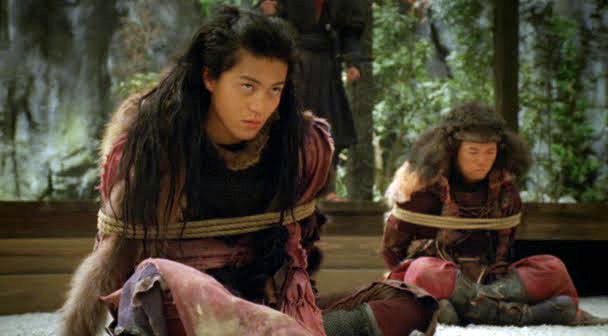
Born the second son of the Hatakeyama family, Naomitsu  (Oguri Shun) had long accepted the fact that his  rank in life was lower than that of his older brother Nobutsuna, (Ikeuchi Hiroyuki), who's the heir and future leader of the family. As a child, he knew better than to challenge his brother's authority, he knew early on that his duty was to serve his family with utmost loyalty. As a grown up, he sought neither power nor glory; to him, happiness meant living a life of obscurity and having enough freedom to do as he pleased.


Naomistu went  about his life oblivious to politics, he couldn't be made to care about wealth or be bothered to find out how much influence he could wield. He was blind to the malicious intent and ambition of others around him, and so when the shogun (Kenichi Hagiwara) unexpectedly  issued a decree declaring the marriage to his betrothed Ako (Shibamoto Yuki) a condition precedent to obtaining the title of  provincial deputy, Naomitsu failed to anticipate the trouble that the said edict would bring on to his family.

The shogun's announcement set off a major controversy, leaving Naomitsu at a loss as to how to allay his older brother's fear of being deposed of his position as head of the clan. He sincerely tells Nobutsuna that he's not interested in obtaining gold or the status of deputy. But all is for naught as the latter's mind is slowly filled with lies told by their adopted brother, Sakuramaru  (Tanaka Kei), who's already made his own bid to acquire the power and position held by the Hatakeyama family. Playing Iago to Nobutsuna's Othello, Sakuramaru incites the insecure older brother to betray his only brother; forcing Naomitsu to flee with Ako into the woods where they come across the bandit Tajomaru (Matsukata Hiroki).


Drawing inspiration from Akutagawa Ryunosuke's short story In a Grove, writers Ichikawa Shinichi and Yamamoto Mataichiro's Tajomaru stands as a brave yet clumsy attempt at doing a fresh and innovative take on the original story. What the screenplay does is, it fills in the events that occurred prior and  subsequent to the discovery of the body in the woods and runs [amok] with it-- thereby producing an alternate account of what transpired whilst providing a backstory to the now legendary bandit from which this movie takes its name.

As a period piece, Tajomaru excels in enticing viewers with its grand scale and lavish production, unfortunately, the plot and execution of it all makes it more of a drab assembly of clichés and contrivances than a brilliant reinvention of a classic tale. For while the original material concerned itself with seven varying accounts told in the course of a murder investigation, Tajomaru merely makes use of certain elements in the literary piece and reproduces key scenes in the Akira Kurosawa adaptation, Rashomon, to create a spin-off with a storyline that can be found in no less than a dozen samurai epic films. The fact that it's unoriginal is not even the main issue, the problem lies in its  lukewarm rendering of classic themes such as love, betrayal and revenge, and its writers' seeming inability to recognize when to stop introducing twists so ludicrous and fanciful that it makes the whole thing unintentionally laughable.  


Tajomaru gives its viewers the initial impression that it's a throwback to sword-fighting films of old; it briefly introduces the characters and their motivations, hints at an impending conflict, and generally sets the stage for its hero to fall to the depths of despair in order to subsequently rise up to reclaim his honor and dignity. Its first forty minutes is pure cinematic gold given that it has all the hallmarks of an enduring tragedy wherein a simple misunderstanding breaks the tenuous equilibrium that exists within a family.  That being said, it's set up  rather nicely, as the movie opens with a simple voice over, laced with a melancholy that only comes with narrating things past. It's complimented by breathtaking cinematography that captures the changing of the seasons, for as spring slowly gives way to fall, two brothers are seen to compete to gain one woman's hand in marriage, furthermore, a trusted servant reveals himself to be the snake that he is. Its overall look and tenor evokes that of a Shakespearean tragedy, but sadly, the extent of its hook ends in the setting of its lush landscape and intricately designed costume pieces, because  beneath all that style and gloss is a story that never really managed to make sense of what genre it wanted to belong to, such that its focus kept on shifting every quarter of the film.

The movie is layered with conflict-- it has a virtual blitzkrieg of dramatic events that would lead anyone to believe and anticipate that the protagonist would eventually be given the means and opportunity to seek revenge under a new identity. That in itself would have sufficed, the rub is that as one dramatic event was followed by another, the more far-fetched the story became and the less satisfying was the outcome. There were too many elements in it alien to the story; the pop-rock Robin Hood-esque montage and rap sequence negate the tone and gravity established in the first half of the film, while a last-minute twist merely serves as an overture to a nonsensical trip to hell and back, which was mere padding  for the story. And it literally is a trip to "hell" and back. 


The inclusion of a modern track in the middle of the film would not have been so out of place if this movie had the same flighty humor as director Nakano Hiroyuki's Red Shadow: Akakage or the "ninja-splatter punk" style of Kitamura Ryuhei's Azumi where a freakishly made-up Odagiri Jo played a bishonen assassin. But Tajomaru is not the type of movie to fall under any of the aforementioned category. It presents itself to be more than what it actually is---it's supposed to be this serious film based on a classic story but in reality, all it is, is a melodramatic film that's so turgid, one can't wait for the closing credits to roll on screen. 

Perhaps the biggest shortcoming of this movie is that it has a hero that's content to just pander and coast along without any predetermined goal, direction or zeal. Naomitsu does not have the grit and heart typical of heroes  in this genre, he's easily disheartened and weak without his lady love. He's no Edmond Dantès or Crisostomo Ibarra, that's for sure, as he spends a good amount of the movie looking hurt, betrayed and intensely sissyfied despite the dreadlocks and the fur overcoat. Oguri Shun tries hard to lend credence to such a pathetic character, looking exaggeratedly forlorn and wistful, and at times mad with rage and comically homicidal. He sobs, he snarls in anger, looks dejected and even throws his head back to wail at the sky and survives  what appears to be at least a 12-ft jump before finally deciding take action against the enemy. There's very little character development in this production, so the rest of the cast can't be expected to do any better-- Ikeuchi Hiroyuki plays Nobutsuna with a permanent look of dissatisfaction on his face, showing no hint of affection or consideration for his younger brother contrary to the portrayal of his child version; Shibamoto Yuki looks resplendent in colorful silk robes but her turn as the defiled and self-sacrificing Ako makes for one beleaguered heroine that serves no purpose but to turn this movie's hero into a whimpering idiot. And even though Tanaka Kei gets to play a marvelous villain, the conclusion to the sword fight and his dying words in the end only emphasize how unbelievably moronic this movie turned out to be.

So if you're planning on watching this, be sure to remember the following:  (1) lower your expectations;  (2) have a good laugh; and (3) be done with it. Don't lament having wasted your time and money on it. 
Read More